2026-11-18
Midlife Women's Hair Loss in Daechi-dong: Have You Checked Your Own Hair While Managing Your Kids' Schedules?
A Daechi-dong clinic director explains why midlife women lose volume at the part and crown, whether thinned hair can recover, and three treatment options.

Hello.
I am Dr. Kim Da-jeong, Director and Head Physician of Cordia Clinic.
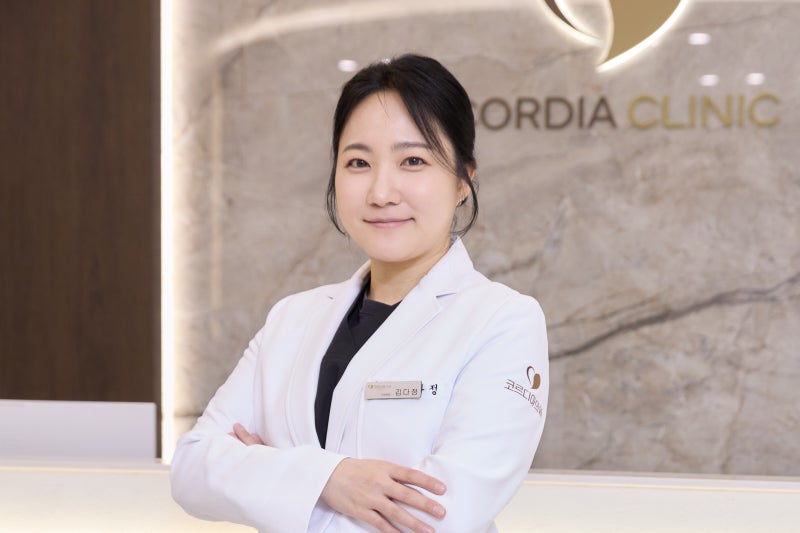
[Premium Hair Loss Treatment] Cordia Clinic · Dr. Kim Da-jeong, Director | ||
<1:1 Customized Diagnosis> Based on tens of thousands of clinical data points, Precision focus and technique honed through surgical training | ||
Accurate analysis based on 3D AFS precision diagnostics <Precision Diagnostic System> | ||
Sustainable hair loss treatment achieved with a low-pain system <Pain Management Know-How> |
Mothers raising children in Daechi-dong lead such busy lives.
Since my clinic is nearby, I often see Daechi-dong mothers on my way to work.
It is something of an occupational habit, but I always notice their hair first.
Sometimes I wonder, “Are they getting treatment for hair loss?”
“Do they even realize they have hair loss?”
I find myself curious about it from time to time.
Between checking children’s school and academy schedules and looking after the rest of the family, it is easy for your own time to get pushed aside.
Have you ever glanced in the mirror and thought something like this?
“My part looks wider than it used to…” “Why does my hair look so much thinner when I tie it back?”
Yet you may never have actually checked how your own hair is changing.
Today, I will talk about why midlife women’s hair volume thins, how it can be treated, and three things you should check right now.
<Treatment Philosophy>
Why does hair thin at the crown in midlife women?
In their 40s and 50s, women’s bodies go through many changes.
Especially around menopause, estrogen levels drop, and the hormonal environment that influences hair growth can also shift.
When genetic predisposition and aging also come into play, female pattern hair loss (FPHL) may develop.
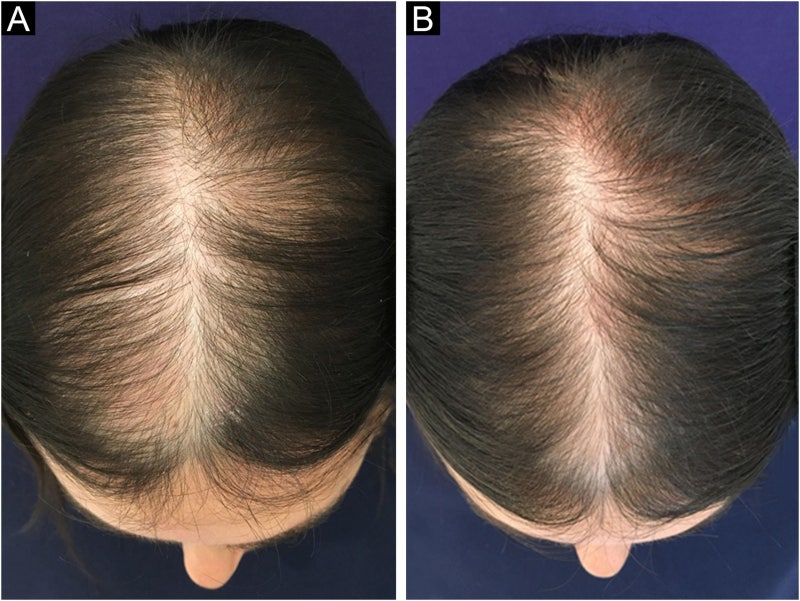
Top-down views (A and B) of a woman's scalp, showing a widened part and thinning hair across the crown.
A hallmark of female pattern hair loss is gradual thinning of the hair along the part and around the crown.
This process is known as “follicular miniaturization.”
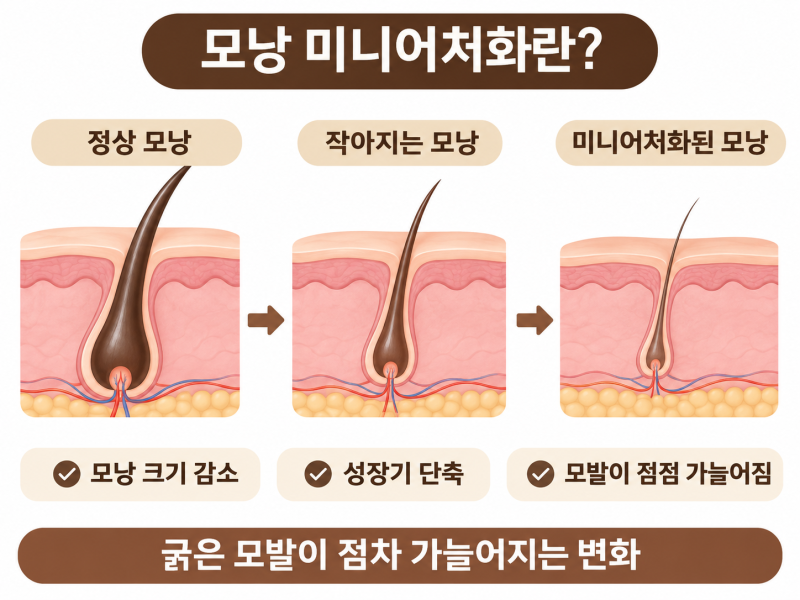
Follicle miniaturization: a normal follicle shrinks step by step, its growth phase shortens, and thick hair gradually becomes thinner.
That said, not all hair loss in midlife women is caused by menopause.
Iron deficiency, thyroid disease, and telogen effluvium (temporary shedding) triggered by rapid weight loss also need to be ruled out.
Can thinned hair become thick again?
Here is some reassuring news.
Thinning hair is not the same as the follicle having completely disappeared.
If a follicle is still producing hair, treatment may improve hair thickness and density.
However, in areas where follicle function has already declined significantly, the extent of recovery may be limited.
That is why, when I evaluate hair loss, I look not only at how much hair has already been lost,
but also at how much thinned hair is still remaining.
How should female hair loss treatment begin?
There are several treatment options for female pattern hair loss.
Let me introduce three of them.
The first is minoxidil treatment.
Topical minoxidil is the standard treatment for female pattern hair loss.

Rogaine 5% minoxidil foam, labeled a hair loss treatment; the box says twice daily for men, once daily for women.
When necessary, low-dose oral minoxidil can also be considered. However, using oral minoxidil for hair loss is off-label, and side effects such as edema, rapid heartbeat (tachycardia), and excessive hair growth (hirsutism) must be monitored.
The second is hormone-related medication.
Depending on the patient’s condition, anti-androgen drugs such as spironolactone may also be considered.
However, blood pressure, kidney function, potassium levels, and the possibility of pregnancy must be checked, so an individualized assessment is necessary.
These are the ingredients typically prescribed at clinics known as go-to spots for hair loss medication.
The third is scalp injections and adjunctive treatments.
Treatments such as PRP, scalp botulinum toxin, and PDRN are also being studied to improve the environment around follicles and promote hair growth.
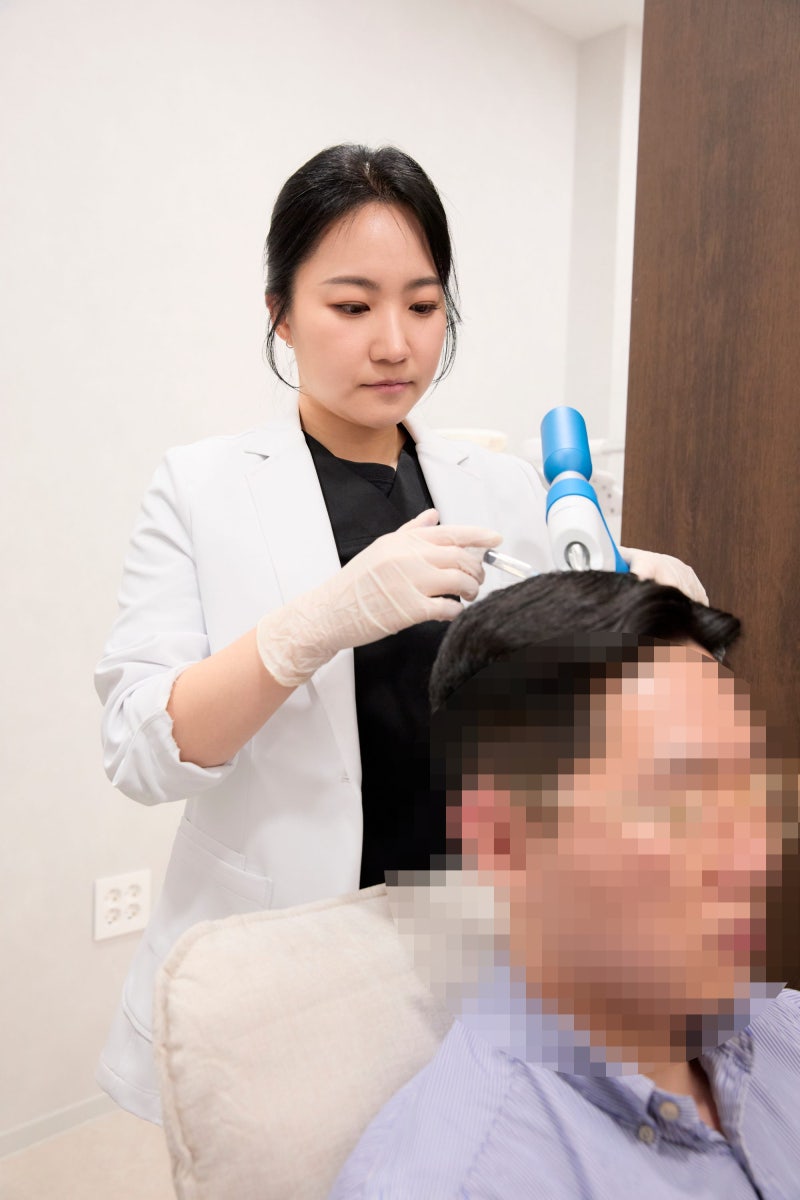
A gloved doctor uses a handheld injection device on the scalp of a seated patient, whose face is blurred.
Some studies have reported positive results for improving hair density and thickness.
However, the level of evidence and effectiveness vary by ingredient, so these are best chosen as adjunctive options based on the patient’s stage of hair loss and prior treatments.
Low-level light therapy (LLLT) is another non-drug option worth considering.
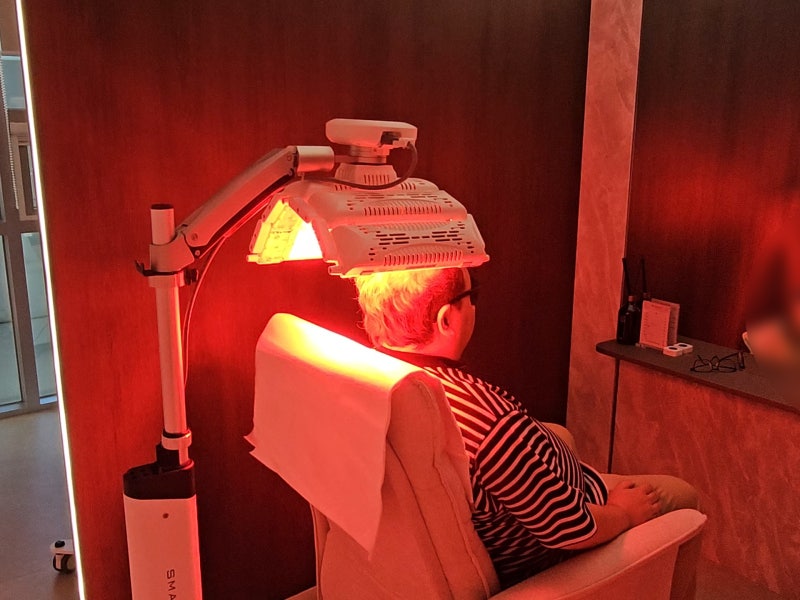
A patient sits in a chair under an LED device that shines red light over the head.
Whichever method you choose, it is important to track changes over a sufficient period of time.
For female pattern hair loss, treatment response is generally evaluated over about 6 to 12 months.
Closing Thoughts
Of course, it is important to worry about your child’s grades and future path and to look after your family’s health.
But I hope you will also give the same attention to your own health and changes.
Hair loss is not just a matter of appearance. It can affect how confident you feel about yourself and how satisfied you are with your everyday life.
“After all the time you have spent caring for your family, isn’t it time to look after yourself, too?”
To start, try a scalp magnification exam (trichoscopy) to check your hair thickness, density, and follicle condition.
I first check follicle density, hair thickness, and other data through a 3D AFS scalp imaging exam.
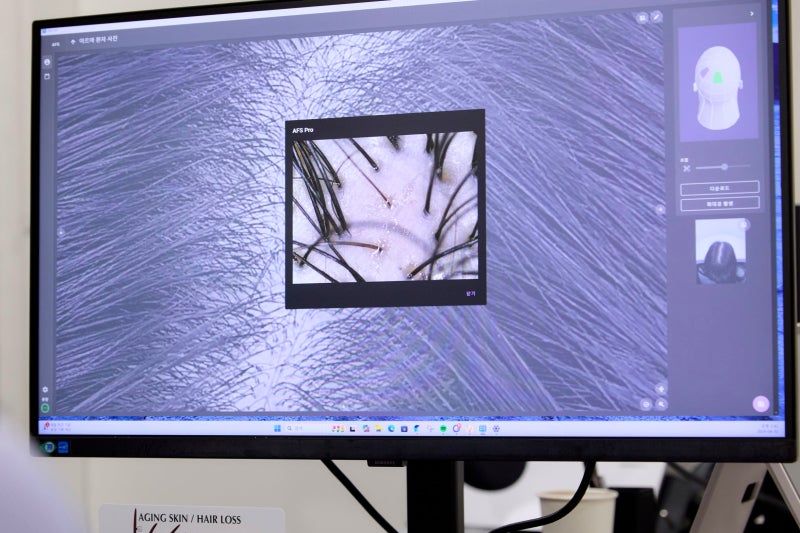
Checking whether fine hair along the part and crown is actually increasing, and whether other causes of hair loss might be involved, is the first step in deciding the direction of treatment.
Just as you plan for your child’s future, I hope you will also make a healthy plan for your own future.
This has been Dr. Kim Da-jeong, Director and Head Physician of Cordia Clinic, sharing thoughts on female hair loss concerns in Daechi-dong.
Thank you.
〈Q&A〉
Frequently Asked Questions
Question | Answer |
Q. Can hair loss that begins in your 50s be treated? | Yes. Depending on the health of your follicles, it is possible to slow progression or improve hair thickness and density. |
Q. If hair loss starts after menopause, is hormone therapy necessary? | Not necessarily. Female pattern hair loss has multiple causes, so treatment should be matched to the type of hair loss. |
Q. Can hair loss be diagnosed with a scalp magnification exam alone? | It helps assess differences in hair thickness and scalp condition. When needed, we combine it with a medical history review and additional tests. |
< Related Posts You May Find Helpful >
<Inquiries – Naver TalkTalk>
<Cordia Clinic Notice> | ||
At Cordia Clinic, to provide each patient with thorough consultation and personalized care, we operate on a 100% appointment-only basis. To ensure high-quality care and a private clinical environment, we accept only a limited number of appointments, so it may be difficult to book your preferred time slot. We appreciate your understanding in advance. We will repay your trust with accurate diagnosis and devoted care. Thank you. |
<Clinic Hours> | ||
Mon · Tue · Thu · Fri: 11:00 ~ 20:00 (Lunch break: 14:00 ~ 15:00) Saturday: 10:00 ~ 16:00 (No lunch break) | ||
6F KR Tower, 429 Seolleung-ro, Gangnam-gu (Exit 3, Seolleung Station) | ||
02-568-8575 |
※ This article is provided for general medical information only. Causes of hair loss and responses to treatment vary by individual, and no treatment is guaranteed to produce identical results.
#DaechiDongHairLoss #DaechiDongFemaleHairLoss #MidlifeWomensHairLoss #PostMenopauseHairLoss #MenopauseHairLoss #FemaleCrownHairLoss #PartingHairLoss #FemaleHairLossTreatment #Minoxidil #FemaleHairLossMedication #ScalpInjection #CordiaClinic