2026-10-03
Oral vs. Topical Minoxidil: What's the Difference? | Seolleung Hair Loss Clinic
Explore the key differences between oral and topical minoxidil for hair loss, including clinical trial comparisons, side effect profiles, and long-term adherence tips.
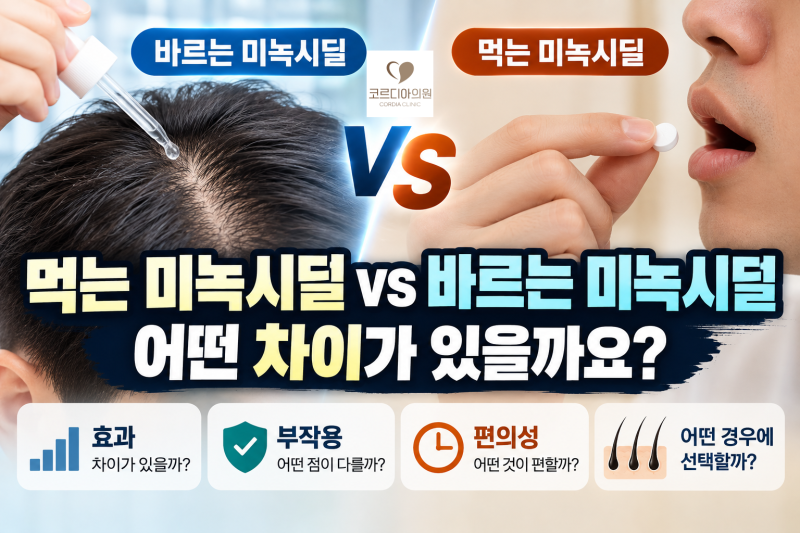
Hello. I am Dr. Da-jeong Kim, Lead Director of Cordia Clinic.
Today's topic is minoxidil.
When researching hair loss treatments, there is one name you will almost always come across.
That is **minoxidil**.
However, once you start looking into minoxidil, another dilemma arises.
“What is the difference between topical minoxidil and oral minoxidil?”
“Is the oral medication stronger?”
“Applying it is such a hassle; can I just switch to pills?”
“I heard oral minoxidil is a blood pressure medication—is it really safe?”
In reality, while **topical minoxidil** and **low-dose oral minoxidil (LDOM)** share the same active ingredient, their pros and cons differ significantly due to their different routes of administration.
Today, I will break down the efficacy, convenience, side effects, and selection criteria for both treatments in an easy-to-understand manner, supported by recent clinical studies.
To start with the bottom line:
Here is a brief summary of the two options.
Topical Minoxidil
→ Applied directly to the scalp
→ A long-established standard treatment for both male and female pattern hair loss
→ Relatively lower risk of systemic side effects
→ Daily application can be cumbersome, and it may cause scalp irritation
Oral Minoxidil
→ Taken as a tablet
→ Eliminates the hassle of daily scalp application
→ Increasingly utilized in hair loss management recently
→ However, its use for hair loss is an off-label, low-dose treatment; because it works systemically, side effects such as hypertrichosis, edema, dizziness, and changes in heart rate must be considered
And there is one crucial fact to keep in mind.
Based on head-to-head comparative studies published to date,
there is insufficient evidence to claim that “oral minoxidil is unconditionally superior in efficacy compared to topical minoxidil.”
Minoxidil Was Not Originally a Hair Loss Medication
Interestingly, minoxidil was not originally developed as a hair loss therapy.
It was initially developed as a vasodilator to lower blood pressure.
However, excessive body hair growth—known as **hypertrichosis**—was observed as an unexpected side effect in patients taking the medication.
Noticing this effect, researchers developed a formulation to be applied directly to the scalp, leading topical minoxidil to become a flagship treatment for male and female pattern hair loss.
Recently, **low-dose oral minoxidil (LDOM)** has gained substantial research attention as a systemic alternative for hair loss therapy.
How Does Minoxidil Work on Hair?
It is difficult to explain minoxidil's hair growth mechanism through a single pathway alone.
Current scientific consensus suggests that it modulates various biological signals around hair follicles, acting to maintain or prolong the anagen (growth) phase of the hair cycle.
Because of this, minoxidil is widely used for:
Male pattern hair loss
Female pattern hair loss
While it is sometimes used adjunctively in other forms of alopecia depending on clinical judgment, minoxidil alone cannot resolve every type of hair loss.
For conditions with different underlying mechanisms, such as alopecia areata or scarring alopecia, targeted treatments tailored to the specific cause are required.
What Kind of Treatment is Topical Minoxidil?
This is the most familiar formulation.
Liquid or foam minoxidil is applied directly onto the affected scalp areas.
Concentrations and directions vary depending on the product and target patient, with 2% and 5% formulations being the standard choices.
The greatest advantage of topical minoxidil is that its efficacy and safety profile have been thoroughly documented over decades of clinical use.
Furthermore, because the drug is applied locally to the scalp, the burden of systemic exposure and related side effects is relatively low compared to oral minoxidil.
Consequently, it remains one of the foundational pharmacotherapies for androgenetic alopecia.
Why Did Oral Minoxidil Come Into Use?
One of the most practical reasons is that maintaining consistent adherence to topical application is surprisingly challenging.
Many patients start enthusiastically, only to discontinue treatment after a few months.
“Applying it in the morning makes my hair look greasy.”
“I constantly forget to apply it every day.”
“My scalp feels itchy and stings.”
“It's inconvenient to apply right before going out.”
These are common complaints.
Hair loss treatment is rarely a short-term fix; it usually requires long-term maintenance.
Therefore, whether a patient can **consistently sustain the regimen (adherence)** is an essential factor when deciding on a treatment strategy.
In response to these compliance hurdles, low-dose oral minoxidil began to be researched and prescribed as a viable alternative.
Is Oral Minoxidil Approved for Hair Loss?
This is an important point to clarify.
Oral minoxidil was originally approved as an antihypertensive medication.
For hair loss, it is prescribed at a much lower dose than what was traditionally used for severe hypertension, a strategy known as low-dose oral minoxidil (LDOM).
However, prescribing oral minoxidil for hair loss is generally an **off-label use**.
An international expert consensus published in JAMA Dermatology in 2025 highlighted that while clinical adoption of LDOM is rising, more research is still needed regarding its long-term safety profile and optimal dosing protocols.
Therefore,
it is not appropriate to think, “Everyone seems to be taking it, so it must be just like a common hair supplement.”
Oral vs. Topical Minoxidil: Which is More Effective?
This is likely the question you are most curious about.
Recently, randomized clinical trials directly comparing the two modalities have been published.
A 2024 study published in the Journal of Cosmetic Dermatology evaluated 65 patients with androgenetic alopecia divided into:
Oral minoxidil 1 mg/day
versus
Topical minoxidil 5%
over a 6-month period.
Both groups achieved statistically significant improvements in hair diameter, but the difference between the two groups was not statistically significant.
In other words, this study did not demonstrate a definitive clinical superiority of oral minoxidil over topical minoxidil.
Oral Minoxidil 5 mg Was Also Directly Compared in Male Hair Loss
A randomized clinical trial focusing on male androgenetic alopecia was published in JAMA Dermatology in 2024.
This study compared:
Oral minoxidil 5 mg once daily
versus
Topical minoxidil 5% twice daily
over 24 weeks.
A total of 90 patients enrolled, and 68 completed the trial.
Looking at the results, there was no statistically significant difference between the two groups regarding changes in terminal hair density and total hair density measured at the frontal and vertex scalp.
Photographic assessments showed slightly superior cosmetic improvement on the vertex in the oral group, but no significant difference was observed in the frontal area.
The authors' ultimate conclusion was unambiguous:
Oral minoxidil 5 mg was not proven to be overall superior to topical minoxidil 5%.
What Happens When We Pool Multiple Studies?
In 2024, a meta-analysis synthesizing four randomized clinical trials encompassing 279 patients was published.
The findings were noteworthy.
Between oral minoxidil and topical minoxidil,
there was no significant difference in the degree of improvement in
hair density
or
hair diameter.
In summary, the current body of evidence does not support the simplistic claim that “because it is a pill, it is stronger and vastly more effective than the topical form.”
Rather, based on contemporary medical literature, it is more accurate to view them as two distinct delivery routes offering comparable therapeutic efficacy.
What Are the Advantages of Oral Minoxidil?
The greatest advantage is convenience.
Swallowing a small pill once daily can be far more manageable for individuals who struggle with applying topical formulations to their scalp every day.
For instance, oral therapy may be worth considering if you:
Frequently forget to apply topical solutions
Dislike the sticky, greasy texture topical solutions can leave on your hair
Cannot tolerate topical products due to persistent scalp irritation
In managing alopecia, this practical aspect is vital.
No matter how efficacious a medication is, it cannot yield results if you cannot stick with it.
The Most Common Side Effect of Oral Minoxidil: Hypertrichosis
A hallmark adverse effect of oral minoxidil is hypertrichosis—excessive body hair growth.
Put simply, hair growth may increase not only on the scalp, but also in unwanted areas such as the face, arms, or back.
A large-scale multicenter study evaluated the safety profile of low-dose oral minoxidil.
Analyzing 1,404 hair loss patients, the most frequently reported side effect was **hypertrichosis, occurring in 15.1%** of subjects.
Reported systemic adverse effects included:
Dizziness: 1.7%
Fluid retention / edema: 1.3%
Tachycardia: 0.9%
Headache: 0.4%
Periorbital edema: 0.3%
However, it should be noted that this study was a retrospective multicenter registry rather than a randomized trial.
Furthermore, because dosages and baseline patient characteristics varied, these exact percentages may not apply uniformly to every individual.
Differences in Hypertrichosis Observed in Head-to-Head Studies
In the aforementioned 2024 randomized trial on male pattern hair loss, 49% of participants in the 5 mg oral minoxidil group experienced hypertrichosis.
Additionally, headache was reported in 14% of the oral group.
Furthermore, the meta-analysis combining multiple randomized trials confirmed that hypertrichosis occurred at a significantly higher rate with oral minoxidil than with topical minoxidil.
Consequently, individuals who are sensitive to the prospect of increased facial or body hair should carefully weigh this aspect before initiating treatment.
What Side Effects Can Occur With Topical Minoxidil?
While topical minoxidil carries a lower burden of systemic adverse effects, it has its own set of localized drawbacks.
Common issues include:
Scalp itching
Stinging or burning
Dryness
Scaling and flaking
Contact dermatitis
Patients sensitive to ingredients such as propylene glycol commonly found in liquid solutions may experience noticeable irritation or allergic contact dermatitis.
Additionally, if the solution drips down onto the forehead or face, unwanted facial hair growth can occasionally occur locally.
Thus, dividing the two as
Oral minoxidil = Has side effects
Topical minoxidil = Has no side effects
is clinically inaccurate.
It is better understood as having different profiles of adverse reactions.
Does Oral Minoxidil Lower Blood Pressure Significantly?
When patients learn that minoxidil originated as an antihypertensive medication, this is usually their primary concern.
The low doses used for hair loss are substantially lower than the dosages historically prescribed for severe refractory hypertension.
In large patient cohorts treated for alopecia, systemic side effects like dizziness, tachycardia, and fluid retention occurred at relatively low rates.
However, this does not mean cardiovascular side effects are entirely absent simply because it is a “low dose.”
A thorough assessment of your baseline health is essential prior to starting treatment, especially if you:
Have a tendency toward hypotension (low blood pressure)
Have underlying cardiovascular conditions
Are prone to peripheral edema
Are concurrently taking other blood pressure medications
Experience heart rate irregularities
The 2025 international expert consensus statement also recommends reviewing the patient's medical history and baseline status before initiating oral minoxidil, alongside clinical monitoring when warranted.
Which Option is Better for Women?
Minoxidil is an indispensable therapy for female pattern hair loss as well.
Topical minoxidil has long served as a first-line treatment for women.
Oral minoxidil is also being actively studied and utilized for female pattern hair loss in recent years.
However, in female patients, the emergence of facial hypertrichosis can be a significant factor that affects treatment satisfaction and adherence.
Furthermore, because pharmacologic choices must be strictly modified if a patient is pregnant or planning a pregnancy, consultation with a physician is mandatory.
Rather than deciding simply based on
“Pills are easier to take, so I'll go with oral,”
it is far wiser to select a treatment that fits your comprehensive personal and health circumstances.
Can Minoxidil Cause Increased Hair Shedding Initially?
Yes, it can.
During the initial phase of minoxidil therapy, a temporary increase in hair loss—often called initial shedding—can occur.
Because of this, some patients worry and discontinue use prematurely, thinking:
“Minoxidil made my hair loss worse!”
However, this can happen as hair cycle dynamics shift: existing telogen (resting) hairs are shed to make way for new anagen (growing) hairs.
That said, not all increased shedding is benign initial shedding.
If hair fall is excessively severe or persists for an extended duration, it is advisable to evaluate whether other underlying causes are present.
How Long Must Minoxidil Be Used to Assess Its Efficacy?
Hair loss treatment cannot be judged in just a few days or weeks.
This is because the hair growth cycle is naturally prolonged.
Generally, minoxidil's effectiveness is evaluated after several months of continuous adherence.
Indeed, the comparative clinical trials discussed earlier assessed therapeutic outcomes over 24 weeks or 6 months.
Therefore, evaluating treatment after just one month by thinking,
“My hair hasn't grown back yet, so it must not be working,”
is far too premature.
When possible, taking standardized baseline photos and comparing them at regular intervals under identical lighting and angles can be very helpful.
What Happens If You Stop Using Minoxidil?
Minoxidil does not eliminate the underlying genetic causes of androgenetic alopecia.
If you stop using the medication after maintaining hair growth through treatment, the therapeutic benefits sustained by the drug will gradually diminish over time.
Therefore, androgenetic alopecia should be approached from the perspective of ongoing, long-term maintenance rather than a short course aimed at a definitive “cure.”
This principle applies equally to both oral and topical minoxidil.
How Does It Differ from Finasteride and Dutasteride?
This is another common point of confusion in male pattern hair loss management.
Finasteride & Dutasteride
→ Inhibit 5α-reductase to decrease DHT production and reduce its androgenic influence
Minoxidil
→ Promotes hair growth by stimulating the hair cycle and improving the follicular microenvironment
In other words, their mechanisms of action are distinct.
For this reason, both classes of medication are frequently combined in male pattern hair loss depending on the individual clinical presentation.
One should not be viewed as an outright substitute for the other.
Is It Better to Use Oral and Topical Minoxidil Together?
While this is a possible combination in select clinical scenarios, combining both is certainly not necessary for everyone.
Using oral and topical minoxidil concurrently does not automatically mean hair growth benefits will double.
Physicians typically choose one route or adjust therapy according to therapeutic response, side effect profiles, and daily lifestyle convenience.
Rather than maximizing the number of interventions, establishing a tailored regimen that you can comfortably sustain over the long haul is far more critical.
Oral vs. Topical Minoxidil: A Quick Comparison
Category | Topical Minoxidil | Oral Minoxidil |
Administration | Applied directly to the scalp | Taken orally as a tablet |
Regulatory Approval | Standard approved therapy for androgenetic alopecia | Generally off-label for hair loss |
Recent Comparative Efficacy | Proven efficacy | Comparable efficacy reported |
Main Advantages | Lower risk of systemic exposure | High convenience of daily dosing |
Common Inconveniences | Daily application, scalp irritation, hair greasiness | Hypertrichosis (unwanted body hair) |
Systemic Side Effects | Relatively rare | Dizziness, edema, tachycardia possible |
Long-term Evidence | Extensive and well-established | Growing, but further studies required |
Key Considerations | Scalp sensitivity, long-term compliance | Blood pressure, cardiovascular health, edema, concurrent meds |
Who Should Consider Oral Minoxidil?
Recent international expert consensus panels recognize low-dose oral minoxidil as a valuable option in several specific clinical scenarios.
For example, oral treatment can be considered when:
A patient finds it difficult to maintain daily topical application
Topical therapy cannot be continued due to persistent scalp irritation
A patient experiences severe cosmetic dissatisfaction with topical solutions
Conversely, for individuals with concerns regarding systemic side effects or those with baseline blood pressure and cardiovascular considerations, topical therapy remains the more prudent initial choice.
Ultimately, treatment selection should not be driven by perceived potency alone, but by balancing clinical safety and long-term sustainability.
The Key Factor I Look for When Prescribing Minoxidil: 'Can You Maintain It Long-Term?'
There is one factor in hair loss therapy that is far more decisive than many realize:
Long-term adherence.
No matter how effective a treatment may be on paper,
if a patient stops after a few weeks because “applying it is too tedious,” meaningful therapeutic benefits cannot be achieved.
On the flip side, simply because oral medication is convenient does not justify prescribing it indiscriminately to patients with baseline hypotension or a tendency toward edema.
Therefore, when helping patients select a minoxidil regimen, I prioritize a comprehensive evaluation of:
Type and progression stage of alopecia
Gender and age
Scalp condition and sensitivity
Blood pressure and cardiovascular medical history
Current concomitant medications
Pregnancy planning
Tolerance regarding potential hypertrichosis
Likelihood of maintaining consistent topical application
In Summary: It Is Not a Question of Which Option is 'Stronger'
Oral and topical minoxidil contain the identical therapeutic agent, but they differ in route of delivery and side effect profiles.
Current randomized trials and meta-analyses show that oral minoxidil cannot be definitively declared superior to topical minoxidil in overall efficacy.
Therefore,
instead of asking “Which one is stronger?”
it is much better to ask: “Which method can I safely and consistently sustain over the long haul?”
If you are applying topical minoxidil successfully and achieving stable results, there is no pressing medical need to switch purely because a pill looks more convenient.
Conversely, if keeping up with daily topical application is proving difficult, low-dose oral minoxidil can serve as an effective alternative.
Remember that oral minoxidil acts systemically throughout the body.
Rather than copying dosages shared by others online, it is essential to determine the right protocol after having your hair loss pattern, blood pressure, cardiovascular status, and current medications reviewed by a physician.
Ultimately, successful hair loss management does not come from choosing what appears to be the “most aggressive” treatment, but from finding a personalized balance among efficacy, safety, and long-term compliance.
Key References
Penha MA, et al. Oral Minoxidil vs Topical Minoxidil for Male Androgenetic Alopecia: A Randomized Clinical Trial. JAMA Dermatology. 2024.
Asilian A, et al. Clinical efficacy and safety of low-dose oral minoxidil versus topical solution in the improvement of androgenetic alopecia: A randomized controlled trial. Journal of Cosmetic Dermatology. 2024.
Efficacy and safety of oral minoxidil versus topical solution in androgenetic alopecia: a meta-analysis of randomized clinical trials. 2024.
Vañó-Galván S, et al. Safety of low-dose oral minoxidil for hair loss: A multicenter study of 1404 patients. Journal of the American Academy of Dermatology. 2021.
Akiska YM, et al. Low-Dose Oral Minoxidil Initiation for Patients With Hair Loss: An International Modified Delphi Consensus Statement. JAMA Dermatology. 2025.
Olsen EA, et al. Summation and recommendations for the safe and effective use of topical and oral minoxidil. Journal of the American Academy of Dermatology. 2025.
※ This article is intended to provide general medical information regarding minoxidil and hair loss management. It does not constitute a recommendation for any specific pharmaceutical or administration method. Using oral minoxidil for hair loss requires individualized medical consultation to verify indications, off-label status, and baseline health.
〈Cordia Clinic Reservation Guide〉
To ensure thorough consultations and personalized medical care, Cordia Clinic operates strictly by appointment. Please make a reservation via phone, KakaoTalk, or Naver before visiting.
〈Reservations & Inquiries〉
Phone: 02-568-8575
Feel free to reach out via KakaoTalk or Naver Reservation at your convenience.
〈Clinic Hours〉
Mon, Tue, Thu, Fri: 11:00 AM – 8:00 PM
Lunch Break: 2:00 PM – 3:00 PM
Saturday: 10:00 AM – 4:00 PM
Saturday clinic runs continuously without a lunch break.
〈Location〉
6th Floor, KR Tower, 429 Seolleung-ro, Gangnam-gu, Seoul, Republic of Korea
Cordia Clinic (Exit 3 of Seolleung Station, Burger King building)
Frequently Asked Questions
Is oral minoxidil more effective than topical minoxidil?
No, there is insufficient evidence to claim oral minoxidil is unconditionally superior. Recent randomized trials and meta-analyses show comparable gains in hair density and diameter between both routes. Choice should be guided by compliance, convenience, and individual side-effect risks.
What is the primary side effect of oral minoxidil?
The most common side effect is hypertrichosis (unwanted hair growth on the face or body). Because the drug acts systemically, patients may also experience dizziness, fluid retention or edema, headache, and tachycardia. Cardiovascular evaluation is recommended prior to initiation.
Can minoxidil cause increased hair shedding when first started?
Yes. Many patients experience a transient shedding phase during early treatment. This occurs as resting telogen hairs fall out to transition into new anagen growth cycles. However, if shedding is unusually intense or prolonged, you should be evaluated for other causes.
How long does it take to see results from minoxidil?
Visible improvements generally take several months to manifest due to the length of the hair cycle. Clinical studies evaluate outcomes after at least 24 weeks (around 6 months) of continuous, consistent use before assessing density and diameter changes.