2026-11-21
Planning a Pregnancy While Taking Finasteride or Dutasteride? Should You Stop Your Hair Loss Medication? | Yeoksam-dong Hair Loss Clinic
Taking finasteride or dutasteride doesn't necessarily make conception harder. This guide covers their effects on semen, fetal safety, and when to talk with your doctor about stopping.
Hello. I am Dajeong Kim, director of Cordia Clinic.

Many men taking hair loss medication worry about one thing above all when preparing for marriage or pregnancy.
“I’m taking finasteride. Is it okay if we try for a baby?”
“Do I have to stop dutasteride before we try to conceive?”
To answer briefly, taking finasteride or dutasteride does not necessarily make it harder for a man to conceive.
In fact, there are reports of couples who conceived naturally while the man was taking hair loss medication.
That said, in some men these drugs may affect sperm count or motility, so the decision should be tailored to each individual’s situation.
1. Can hair loss medication affect male fertility?
Finasteride and dutasteride are drugs that block the conversion of testosterone into dihydrotestosterone (DHT).
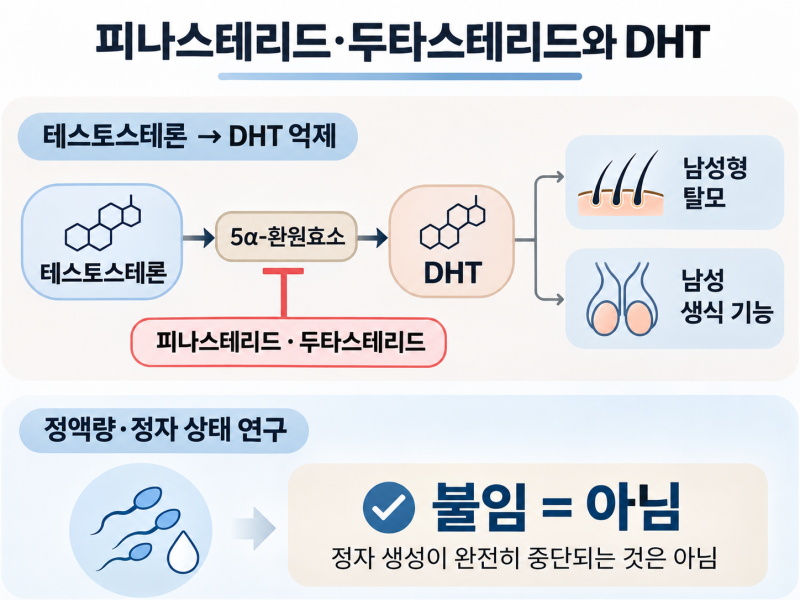
DHT contributes to male pattern hair loss, but it is also a hormone involved in the male reproductive organs.
For this reason, researchers have studied whether drugs that suppress DHT can affect semen volume or sperm quality.
However, suppressing DHT does not completely halt sperm production or cause infertility.
2. Is it okay to get pregnant while taking finasteride?
A 1999 study published in the Journal of Urology compared finasteride 1 mg with a placebo in 181 healthy men.
The results showed no significant differences in sperm concentration, total sperm count, motility, or morphology in the finasteride group.
The UK product licensing information also records pregnancies exposed to the drug through the semen of men taking finasteride, as well as cases of normal births.
This supports the fact that taking finasteride does not necessarily prevent a normal pregnancy.
However, a decrease in sperm count has been reported in some men, and those who already have impaired fertility may be more affected.
3. Is dutasteride different from finasteride?
Dutasteride inhibits both type 1 and type 2 5α-reductase, and it also stays in the body for a relatively long time.
A 2007 study published in the Journal of Clinical Endocrinology & Metabolism compared the effects of finasteride 5 mg and dutasteride 0.5 mg in 99 healthy men.
Some semen parameters decreased, but most of the changes tended to recover after the drug was discontinued.
However, a small study published in 2025 reported that in some men who took dutasteride long-term, semen parameters had not fully recovered even six months after stopping.
So dutasteride does not make pregnancy impossible either, but if you are planning a pregnancy, it is wise to consider both how long you have been taking it and your sperm condition.
4. Can a man’s use of hair loss medication affect the fetus?
Two different situations need to be distinguished here.
It is contraindicated for a pregnant woman to take finasteride or dutasteride herself.
This is because these drugs can affect the development of the external genitalia in a male fetus.
By contrast, when a man takes the drug, the amount excreted in semen is very small.
The UK’s NHS explains that the risk of harm to a fetus through the semen of a man taking finasteride is very low.
Dutasteride is also detected in small amounts in semen, but its effect on a fetus cannot be fully ruled out. For this reason, the product licensing information recommends condom use if the partner is pregnant or may become pregnant.
Pregnant women should also take care to avoid direct contact with crushed finasteride tablets or leaking dutasteride capsules.
5. Should you stop hair loss medication to prepare for pregnancy?
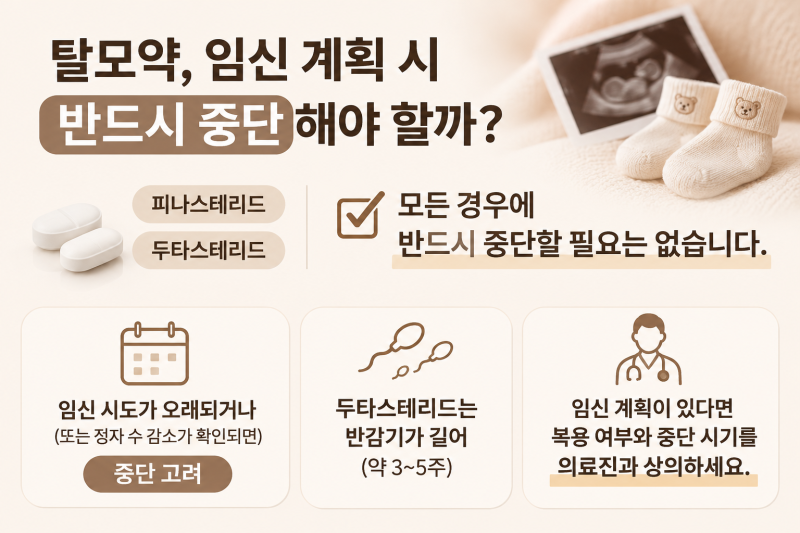
Not every man needs to stop his hair loss medication when preparing for pregnancy.
In particular, if you take finasteride 1 mg and your sperm quality is normal, there is no need to stop it solely because you are planning a pregnancy.
On the other hand, if you have been trying to conceive for a long time or a semen analysis shows a reduced sperm count, stopping the medication may be worth considering.
Dutasteride has a long half-life of about 3 to 5 weeks, so it can remain in the body for a considerable time even after you stop taking it.
If you are planning a pregnancy, it is best to discuss in advance with your healthcare provider whether to keep taking the medication and when to stop.
6. Frequently Asked Questions
Q. My wife became pregnant while I was taking finasteride. Is that okay?
There is not enough evidence to conclude that a fetus will be harmed simply because the father was taking finasteride. The amount of exposure through semen is very small, and in most cases there is no need to worry excessively.
Q. How many months before pregnancy should I stop dutasteride?
There is no established, uniform stopping period that applies to every patient. It should be decided by taking into account the drug’s long half-life and each individual’s fertility status.
Q. Will sperm count recover if I stop hair loss medication?
There are reports of improvement after discontinuation in cases where sperm count decreased in relation to the drug. However, the extent and timing of recovery vary from person to person.
7. If you are planning a pregnancy, check your condition rather than simply quitting the medication
Finasteride and dutasteride are representative medications used to treat male pattern hair loss.
Normal pregnancy is possible even while taking these drugs, and not every user experiences a decline in fertility.
What matters most is not excessive worry about taking hair loss medication itself, but considering the whole picture, including your pregnancy plans, the medication you take, and your sperm condition.
If needed, you can check your fertility through a semen analysis or an evaluation by a urologist, and adjust your hair loss treatment plan accordingly.
References
Overstreet JW, et al. (1999). Chronic treatment with finasteride daily does not affect spermatogenesis or semen production in young men. Journal of Urology.
Amory JK, et al. (2007). The effect of 5α-reductase inhibition with dutasteride and finasteride on semen parameters and serum hormones in healthy men. Journal of Clinical Endocrinology & Metabolism.
Samplaski MK, et al. (2013). Finasteride use in the male infertility population: effects on semen and hormone parameters. Fertility and Sterility.
Long-term use of dutasteride to treat androgenic alopecia in young men may lead to persistent abnormalities in semen parameters. Clinical and Experimental Reproductive Medicine. 2025.
NHS. Fertility and pregnancy while taking finasteride.
UK Electronic Medicines Compendium. Finasteride 1mg and Dutasteride 0.5mg: Summary of Product Characteristics.
※ This article provides general medical information about men taking hair loss medication and planning a pregnancy. It should be distinguished from medication use during pregnancy by women. Please consult your healthcare provider before deciding whether to stop any medication.
〈Cordia Clinic Appointment Information〉
To allow sufficient consultation and individualized care, Cordia Clinic operates by 100% appointment only. Please book by phone, KakaoTalk, or Naver before your visit.
〈Booking & Inquiries〉
Phone: 02-568-8575
Feel free to reach out via KakaoTalk, Naver booking, or any other convenient method.
〈Office Hours〉
Mon, Tue, Thu, Fri: 11:00 AM – 8:00 PM
Lunch break: 2:00 PM – 3:00 PM
Saturday: 10:00 AM – 4:00 PM
We see patients on Saturdays without a lunch break.
〈Directions〉
429 Seolleung-ro, Gangnam-gu, Seoul
Cordia Clinic, 6th Floor, KR Tower
Seolleung Station, Exit 3 (Burger King building)
#FinasterideAndPregnancy #DutasterideAndPregnancy #HairLossMedicationAndPregnancy #PregnancyPrepWithHairLossMeds #FinasterideAndTryingToConceive #DutasterideAndTryingToConceive #StoppingHairLossMeds #HairLossMedSideEffects #FinasterideSideEffects #DutasterideSideEffects #MensHairLossMedication #HairLossMedSemen #FinasterideSperm #DutasterideSperm #LowSpermCount #SpermMotility #SemenAnalysis #MaleInfertility #MaleFertility #TryingToConceive #PregnancyPlanning #MalePatternHairLoss #HairLossTreatment #HairLossMedication #DHT #Finasteride #Dutasteride #SeolleungHairLoss #YeoksamHairLoss #CordiaClinic