2026-11-20
Stinging Scalp and Thinning Hair? Why Scarring Alopecia and Scalp Biopsy Matter | Hair Loss Clinic Near Seolleung Station
Itchy or stinging scalp with thinning hair in one area may signal scarring alopecia. Learn how a scalp biopsy helps diagnosis and why early care protects remaining follicles.
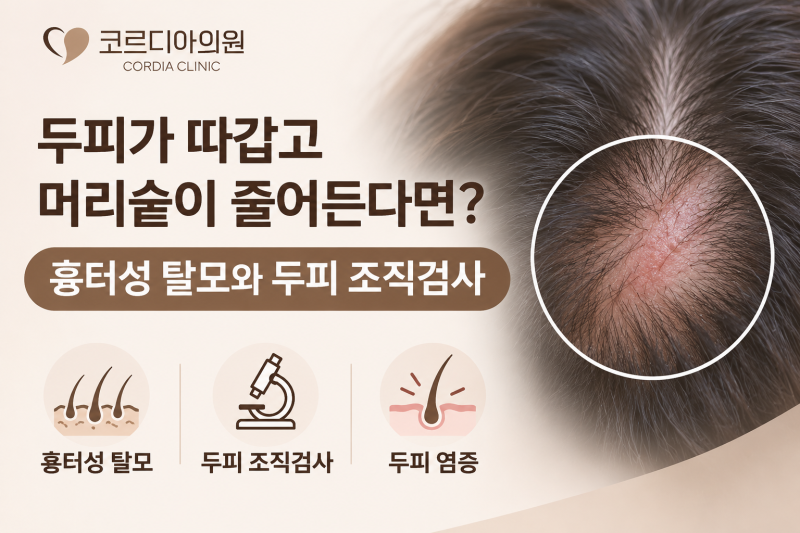
Hello, I am Dr. Kim Da-jeong, Director of Cordia Clinic.

Have you ever experienced stinging or itching in a specific area of your scalp every time you wash your hair?
Today, I would like to share a case I saw during consultations.
At first, it may seem like a simple scalp problem, but over time, some people notice that the hair density in the same area is also decreasing.
If redness or stinging of the scalp persists and the hair in that area gradually thins, scarring alopecia should be considered.
Unlike common pattern hair loss, scarring alopecia can permanently damage the hair follicles themselves, so early diagnosis is important.
Today, we will look at the characteristics and diagnostic methods of scarring alopecia, and why a scalp biopsy may be needed.
1. What Is Scarring Alopecia?
Scarring alopecia is a type of hair loss in which the hair follicles that produce hair are damaged by inflammation or other causes, and the area is replaced by fibrous scar tissue.
In male or female pattern hair loss, the follicles gradually shrink, producing thinner and thinner hairs. This process is known as 'follicular miniaturization.'
In contrast, in scarring alopecia, the hair follicles can be completely destroyed.
Once a follicle has been replaced by scar tissue, it is difficult for hair to grow back in that area.
Therefore, the goal of treating scarring alopecia is less about stimulating hair growth and more about controlling inflammation and protecting the remaining follicles.
2. What Symptoms Does Scarring Alopecia Cause?
One of the representative causes of scarring alopecia is 'lichen planopilaris (Lichen Planopilaris).'
This is a condition in which inflammation develops around the hair follicles, gradually damaging them.
Key symptoms include scalp itching, burning, stinging, and pain.
In particular, redness around the base of the hair or white scales surrounding the hair may be observed.
As the condition progresses, the affected area may look smooth, and the follicular openings, the small holes from which hair emerges, may disappear.
However, not all patients have obvious symptoms, and depending on biopsy findings, the condition may turn out to be a different disease.
Because scarring alopecia can progress even with little or no scalp pain or itching, changes in hair density are also important to watch.
3. How Is It Different from Common Scalp Inflammation?
Not every case of an itchy or flaky scalp is scarring alopecia.
Seborrheic dermatitis and contact dermatitis can also cause the scalp to become red or itchy.
However, if hair gradually thins in a specific area and inflammation around the follicles persists, other causes should be investigated.
During the consultation, we use a scalp dermoscope to examine redness around the follicles, scaling, and changes in the follicular openings.
If you have past photos of the same area, we can also compare them to see whether the hair loss is actually spreading.
When evaluating hair loss, I consider not only current hair density but also where the changes began and how quickly they are progressing.
In particular, if the area of scalp discomfort matches the area where hair is thinning, the possibility of inflammatory hair loss should also be evaluated.
4. When Is a Scalp Biopsy Necessary?
If scarring alopecia is suspected based on examination and dermoscopy but the exact cause is hard to determine, a scalp biopsy may be considered.
A scalp biopsy involves numbing the area with a local anesthetic, taking a small piece of skin tissue, and examining it under a microscope to check for inflammation around the follicles and whether scar tissue has formed.
In cases where lichen planopilaris is suspected, a border area where some hairs remain and inflammation is visible may be more suitable for biopsy than an area where the follicles have already disappeared.
The 2026 position statement from the European Academy of Dermatology and Venereology (EADV) also explains that using dermoscopy to select the biopsy site can help with diagnosis.
However, not every hair loss patient needs a biopsy.
The need for testing is decided by considering examination findings and how the condition is progressing, and if necessary, additional evaluation can be done at a medical institution that performs biopsies.
5. Can Scarring Alopecia Be Treated?
Early detection and control of inflammation are important in scarring alopecia.
For lichen planopilaris, depending on disease activity, options may include topical steroids, intralesional steroid injections, and oral anti-inflammatory or immunomodulatory therapy.
The 2026 EADV position statement also highlights reducing further follicular damage through early treatment as an important goal.
Although it is difficult to restore hair in areas that have already become scarred, slowing damage to the remaining follicles and suppressing the progression of hair loss are important treatment goals.
Also, on a scalp where active inflammation is suspected, an accurate diagnosis and an assessment of whether a procedure is appropriate should come first before general hair-loss injections or microneedling (MTS).
6. Frequently Asked Questions
Q. If my scalp stings, does that mean I have scarring alopecia?
Not necessarily. Similar symptoms can occur with seborrheic dermatitis, contact dermatitis, and other conditions. However, if hair gradually thins in the same area, we recommend a consultation.
Q. How quickly does scarring alopecia progress?
The speed of progression varies depending on the type of condition and the level of inflammatory activity. Changes may appear over a few months, or the condition may progress slowly over a longer period.
Q. Does a scalp biopsy hurt a lot?
Because the procedure is generally performed after local anesthesia, pain during the test can be minimized. After the biopsy, temporary pain, bleeding, or a small scar may remain, so wound care is necessary.
7. Early Detection of Scarring Alopecia Is Important
Unlike common hair loss, scarring alopecia is a condition that can permanently damage the hair follicles.
Therefore, if scalp discomfort persists and hair density decreases in the same area, it is best not to dismiss it as a simple scalp problem and leave it untreated.
In particular, if the hair loss area is spreading quickly or redness, pain, or scaling of the scalp persists, it is important to see a doctor early.
In hair loss treatment, it is important not only to regrow hair but also to protect the follicles that remain.
References
DermNet. Lichen Planopilaris – Clinical Features, Diagnosis and Treatment
Seyed Jafari SM, et al. (2026). Management of classic lichen planopilaris: The EADV task force on hair diseases position statement. Journal of the European Academy of Dermatology and Venereology.
American Academy of Dermatology. Skin biopsy: Wound care
※ This article is intended to provide general medical information and does not replace individual diagnosis or treatment.
〈Cordia Clinic Appointment Information〉
Cordia Clinic operates by appointment only (100%) to ensure sufficient consultation time and individualized care. Please make a reservation by phone, KakaoTalk, or Naver before your visit.
〈Booking and Inquiries〉
Phone: 02-568-8575
Feel free to contact us through KakaoTalk, Naver booking, or any other convenient method.
〈Office Hours〉
Mon, Tue, Thu, Fri: 11:00 AM – 8:00 PM
Lunch break: 2:00 PM – 3:00 PM
Saturday: 10:00 AM – 4:00 PM
We see patients on Saturdays without a lunch break.
〈Directions〉
429 Seolleung-ro, Gangnam-gu, Seoul
6th Floor, KR Tower, Cordia Clinic
Exit 3, Seolleung Station, Burger King building
#ScarringAlopecia #CicatricialAlopecia #ScarringAlopeciaSymptoms #ScarringAlopeciaCauses #ScarringAlopeciaTreatment #LichenPlanopilaris #ScalpBiopsy #ScalpInflammation #ScalpStinging #ScalpItching #ScalpPain #ScalpRedness #ScalpScaling #FollicleInflammation #FollicleDamage #FollicleOpening #PatchyHairLoss #CrownHairLoss #HairThinning #EarlyHairLossSymptoms #HairLossCauses #HairLossDiagnosis #HairLossTest #Dermoscopy #ScalpExam #ScalpDiagnosis #HairLossTreatment #ScalpHealth #SeolleungHairLoss #CordiaClinic