2026-11-24
Thin Front Hair: M-Shaped Hair Loss or a Natural Hairline? How to Tell | Seolleung Station Hair Loss Clinic
A clinic director explains how to tell a naturally M-shaped hairline from early male pattern hair loss, focusing on changes over time, hair thickness, and overall density.
Hello. I am Da-jeong Kim, Director of Cordia Clinic.
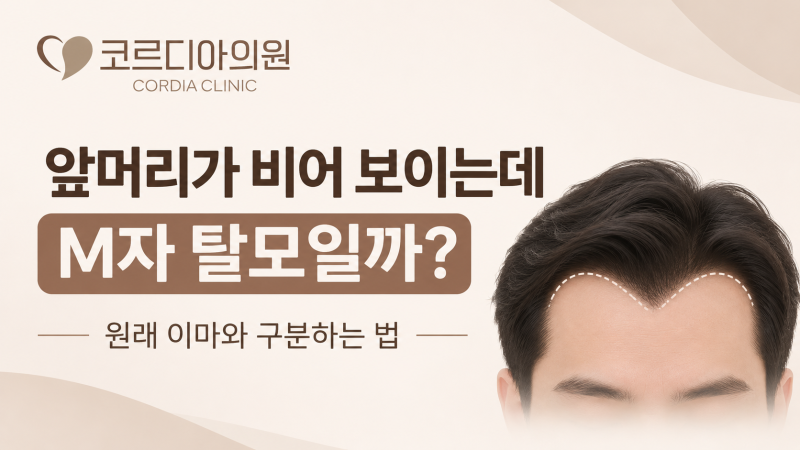
If you look in the mirror and notice that the area around your temples seems thinner than before, you may be worried that M-shaped hair loss has started.
Today, a patient came in to check whether they had M-shaped hair loss.
People with naturally wide foreheads or M-shaped hairlines find it especially hard to tell the difference.
To answer the question up front: having an M-shaped forehead does not necessarily mean you have hair loss.
What matters more than the original forehead shape is whether your hairline has moved backward compared with before, and whether your hair is gradually becoming thinner.
Today, I will explain the early signs of M-shaped hair loss and how to distinguish them from a naturally M-shaped forehead.
1. Can some people naturally have an M-shaped forehead?
The width of the forehead and the shape of the hairline vary from person to person.
Some people are born with a slightly recessed M-shaped hairline at both temples.
In addition, the position and shape of the hairline can change as a person moves from adolescence into adulthood.
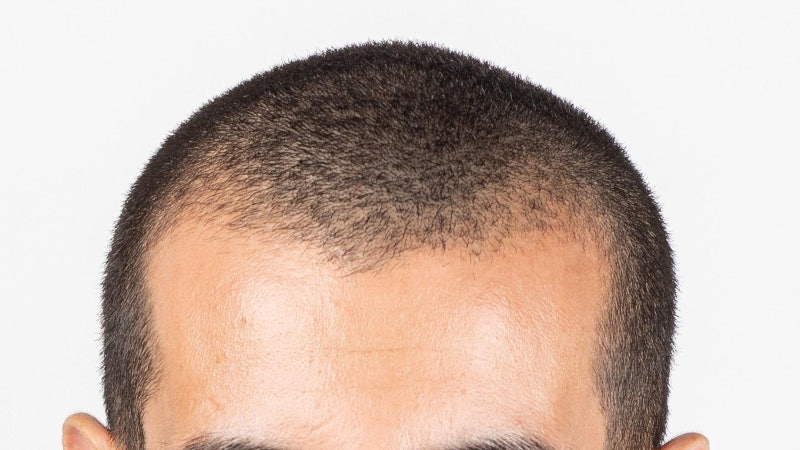
Close-up of a man's short-cropped hairline, with the hair receding at both temples and thinner over the front.
This is commonly called a “mature hairline.”
Such changes do not necessarily indicate pathological hair loss.
In particular, if the hairline has not changed much over a long period and the thickness and density of the surrounding hair are maintained, it may simply be a normal forehead shape.
2. Why does M-shaped hair loss occur?
Male pattern hair loss develops under the influence of genetic predisposition and male hormones.
In particular, dihydrotestosterone (DHT) is involved in shortening the growth phase of hair follicles that are genetically sensitive to it.
Through this process, the follicles gradually shrink, a process known as “follicular miniaturization.”
Hair that was once thick becomes thinner, and as the growth phase shortens, the number of short, weak hairs increases.
When these changes progress at the temples and the front hairline, the hairline gradually recedes backward, and the M shape can become more pronounced.
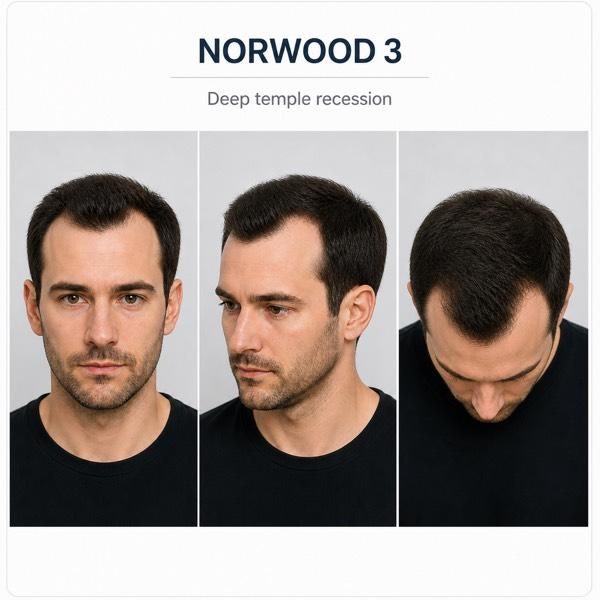
Norwood 3 example: a man shown from the front, side and top, with deep recession at both temples.
The Korea Disease Control and Prevention Agency’s National Health Information Portal also describes male pattern hair loss as involving gradual thinning of hair at the front and crown, with the hairline moving backward.
3. How do you distinguish M-shaped hair loss from a natural forehead?
① Compare old photos with your current hairline
The first thing to check is how things change over time.
If your temple area has gradually moved backward compared with photos from 6 months or 1–2 years ago, hair loss may be a possibility.
Conversely, if your hairline has looked similar since childhood and there is no clear change, it may simply be your natural hairline.
② Check the hair thickness around the hairline
In early M-shaped hair loss, hair often becomes thinner gradually rather than disappearing all at once.
In particular, if thick and very fine hairs are mixed irregularly around the hairline, follicular miniaturization may be suspected.
A 2024 systematic review of trichoscopy studies also identified uneven hair shaft thickness as an important diagnostic finding in both male and female pattern hair loss.
③ Check overall hair density
In addition to the shape of the hairline, you should also check the hair density across the front and crown.
As M-shaped hair loss progresses, the density of the entire front hairline may decrease, and crown hair loss may also develop.
However, hairlines vary greatly between individuals, so it is difficult to make an accurate judgment by sight alone.
4. What should you do if you suspect M-shaped hair loss?
If you suspect M-shaped hair loss, it helps to check the thickness and density of your hair with scalp dermoscopy (trichoscopy).
When I evaluate hair loss, I consider it important to look not only at the current hairline shape but also at past photos and changes in hair thickness.
Especially in the early stage, while hair follicles are still present, drug therapy may help slow the progression of hair loss and maintain hair condition.
For male pattern hair loss, treatments such as finasteride, dutasteride, and minoxidil may be considered.
However, the choice of treatment should be determined by age, sex, the extent of hair loss, and overall health status.
5. Frequently asked questions
Q. If four fingers fit across my forehead, do I have hair loss?
No. Forehead width varies widely between people, so hair loss cannot be determined from the number of fingers alone.
Q. If I have many short hairs in my M-shaped area, does that mean I have hair loss?
Not necessarily. Even a normal hairline can have fine baby hairs. However, if hair that used to be thick is gradually becoming thinner, it is worth checking.
Q. If my father has hair loss, will I also develop M-shaped hair loss?
Genetic factors are involved in male pattern hair loss, but it does not always develop. Hair loss-related genes can be inherited from both the father’s and mother’s side.
Q. Can M-shaped hair loss be reversed?
In the early stages, treatment may improve hair thickness and density. However, if the hair follicles have shrunk significantly, the extent of recovery may be limited.
6. What matters most is changes in your hair, not the shape of your forehead
Having an M-shaped forehead does not mean that everyone needs hair loss treatment.
However, if hair at the temples is gradually thinning and the hairline is moving backward, it may be an early sign of male pattern hair loss.
In particular, if the hairline recedes rapidly over a short period, or if redness, pain, or loss of eyebrow hair accompany the changes, other causes of hair loss should also be evaluated.
The most important criterion for identifying M-shaped hair loss is not how wide the forehead is, but how the thickness and density of your hair change over time.
References
Korea Disease Control and Prevention Agency, National Health Information Portal. Male Pattern Hair Loss.
American Academy of Dermatology. What is male pattern hair loss, and can it be treated?
Trichoscopy of Androgenetic Alopecia: A Systematic Review. Journal of Clinical Medicine. 2024.
British Association of Dermatologists. Hair loss, male pattern (androgenetic alopecia).
※ This article is written for general medical information purposes only. Actual diagnosis and treatment may vary depending on each individual’s scalp and hair condition.
〈Cordia Clinic Appointment Information〉
Cordia Clinic operates on a 100% appointment-only basis to allow for thorough consultations and individualized care. Please book in advance by phone, KakaoTalk, or Naver before your visit.
〈Booking and Inquiries〉
Phone: 02-568-8575
Please contact us by phone, KakaoTalk, or Naver booking, whichever is most convenient for you.
〈Opening Hours〉
Mon, Tue, Thu, Fri: 11:00 AM – 8:00 PM
Lunch break: 2:00 PM – 3:00 PM
Saturday: 10:00 AM – 4:00 PM
We see patients on Saturdays without a lunch break.
〈Directions〉
429 Seolleung-ro, Gangnam-gu, Seoul, Republic of Korea
Cordia Clinic, 6th Floor, KR Tower
Exit 3, Seolleung Station, the building with Burger King
#MShapedHairLoss #EarlyMShapedHairLoss #EarlySymptomsOfMShapedHairLoss #HowToTellMShapedHairLoss #CheckMShapedHairLoss #CausesOfMShapedHairLoss #MShapedHairLossTreatment #MShapedForehead #MShapedHairline #WideForehead #ForeheadHairLoss #FrontHairLoss #ThinningFrontHair #TempleHairLoss #HairlineHairLoss #HairlineRecession #MatureHairline #FollicularMiniaturization #FineHair #SelfCheckHairLoss #HairLossDiagnosis #MalePatternHairLoss #HereditaryHairLoss #DHTHairLoss #Finasteride #Dutasteride #Minoxidil #EarlySymptomsOfHairLoss #SeolleungHairLoss #YeoksamHairLoss