2026-11-15
Will Existing Hair Loss Medications Still Be Needed When New Drugs Arrive? 3 Insights from the Latest 2026 Research
New hair loss drugs are in development, but existing medications remain essential. A 2026 review stresses protecting remaining follicles and notes the limits of scalp injection therapies.
Hello.
This is Dajeong Kim, Principal Physician at Cordia Clinic.

New research on hair loss treatment continues to be published steadily.
Beyond existing oral hair loss medications, the field of research is expanding to include injectable finasteride, new hair loss drugs with novel mechanisms, and regenerative treatments such as exosomes.
When you hear news like this, it is only natural to wonder about it.
“Should I wait until a new hair loss drug comes out?” “Won’t there be a better treatment than the one I’m taking now?”
To cut to the chase, although new treatments are being developed, existing hair loss medications still play an important role for now.
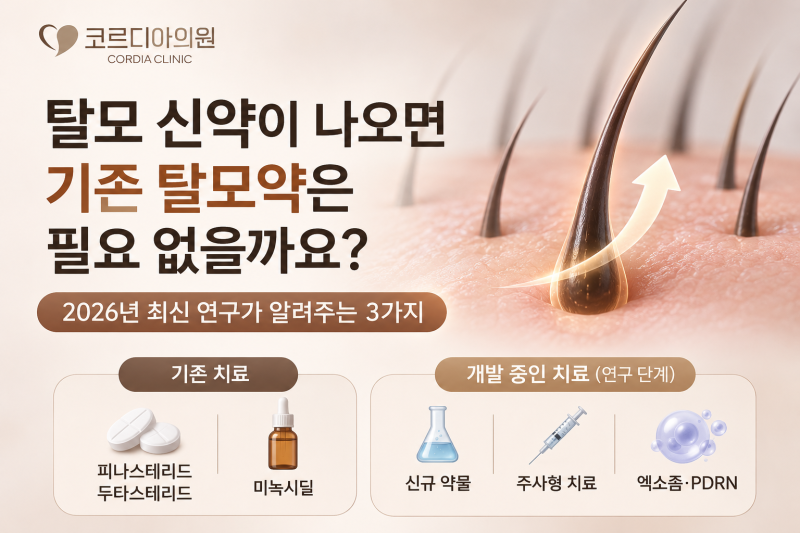
A review article published in Expert Review of Clinical Pharmacology in November 2026 also emphasized this point.
Today, I will share three points that can be confirmed through the latest research.
Table of Contents
Why do existing hair loss medications still matter?
What new hair loss treatments are being developed?
What role do scalp injection treatments such as exosomes and PDRN play?
1. Why do existing hair loss medications still matter?
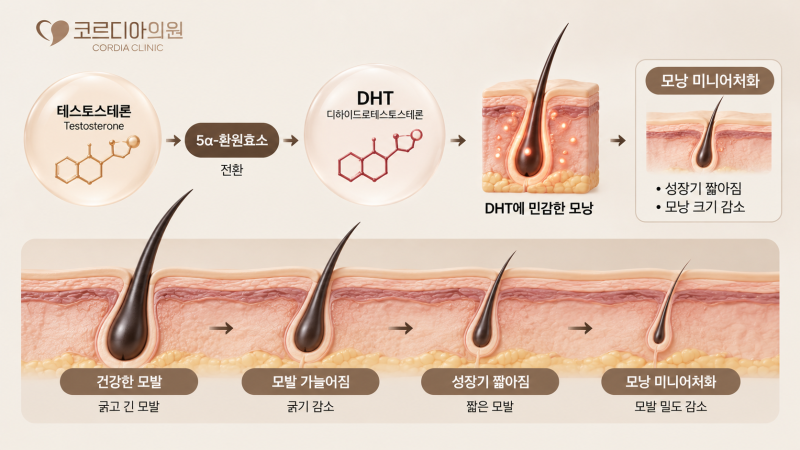
First, it is important to understand how male pattern hair loss progresses.
In male pattern hair loss, hair follicles gradually shrink under the influence of genetic predisposition and dihydrotestosterone (DHT).
This is called “follicular miniaturization.”
Thicker hairs gradually become finer, and as the growth phase gets shorter, overall hair volume declines.
Finasteride and dutasteride help slow these changes by inhibiting DHT production.
Minoxidil promotes hair growth and is involved in maintaining the growth phase.
This review also explained that existing drug treatments are especially effective in the early stages of hair loss and play an important role in inhibiting further follicular shrinkage and improving the thickness of existing hair.
“It is more important to protect the hair follicles that remain than to try to revive those that have already disappeared.”
In my hair loss consultations, I pay close attention not only to current hair density but also to how much thinned hair remains.
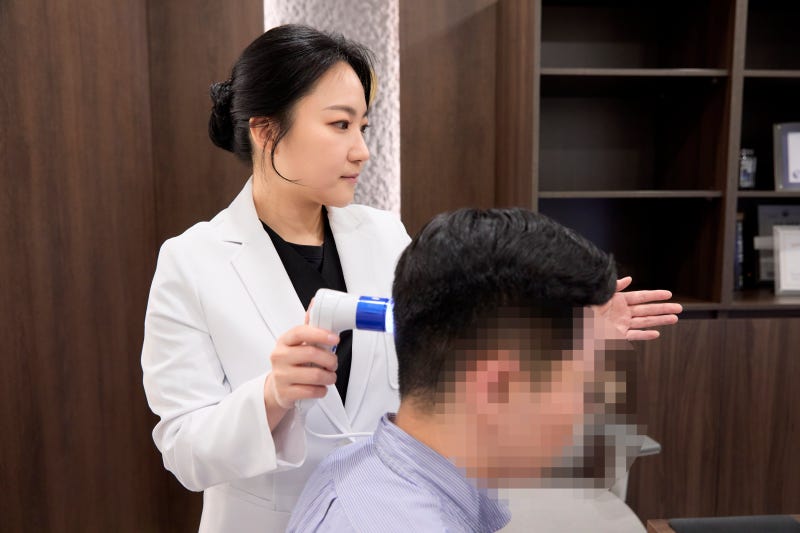
This is because treatment goals differ between follicles that may regain thickness with treatment and areas where damage has already advanced severely.
2. What new hair loss treatments are being developed?
Recently, hair loss treatments that act differently from existing drugs are also being studied.
Representative candidates include the following.
① Clascoterone
This is a topical treatment that acts on androgen receptors to block hormonal signals.
② GT20029
This is a drug with a novel mechanism that induces the degradation of the androgen receptor itself.
③ PP405
This is a candidate therapy that targets metabolic pathways associated with the activity of hair follicle stem cells.
In addition, various treatments are being developed, including sustained-release minoxidil, injectable finasteride, and HMI-115, which targets the prolactin receptor.
However, showing promise in research is not the same as establishing a treatment that can actually be used in patients.
Long-term efficacy, safety, and regulatory approval status still need to be verified.
3. What role do scalp injection treatments such as exosomes and PDRN play?
Recently, treatments that involve the environment around hair follicles and tissue regeneration have also drawn attention.
Exosomes are being studied for their potential to influence hair growth-related pathways through intercellular signaling.
PDRN and polynucleotide (PN) are also ingredients being studied in relation to tissue repair and the environment around hair follicles.
Positive research findings suggesting possible improvements in hair density or thickness have been reported for these treatments.
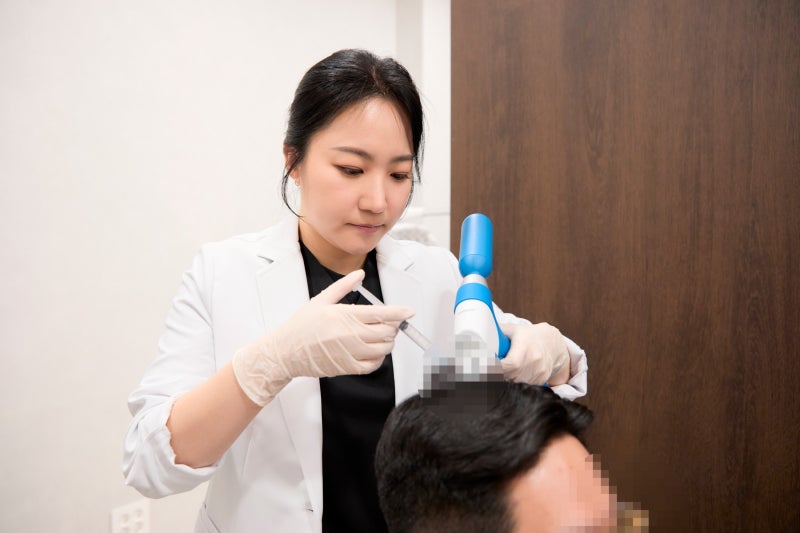
However, this review pointed out limitations: manufacturing methods and administration techniques vary across products, and there is a lack of sufficiently large randomized controlled trials.
Therefore, injection therapy may be considered as a supplementary option depending on the patient's hair loss status and prior treatment history, but it is difficult to regard it as a standard treatment that fully replaces drug therapy.
In Closing
From this latest research, there is one message I consider especially important.
Developing new hair loss treatments is important, but protecting the hair follicles that remain today is equally important.
In particular, male pattern hair loss can lead to progressive follicular miniaturization over time.
If you are considering hair loss treatment in Seolleung, rather than waiting for new treatments to come out, I recommend first checking your current hair condition and how far the hair loss has progressed.
“While you wait for future treatments, your hair is continuing to change right now.”
Understanding your condition accurately and choosing a sustainable treatment direction is the starting point of long-term hair loss management.
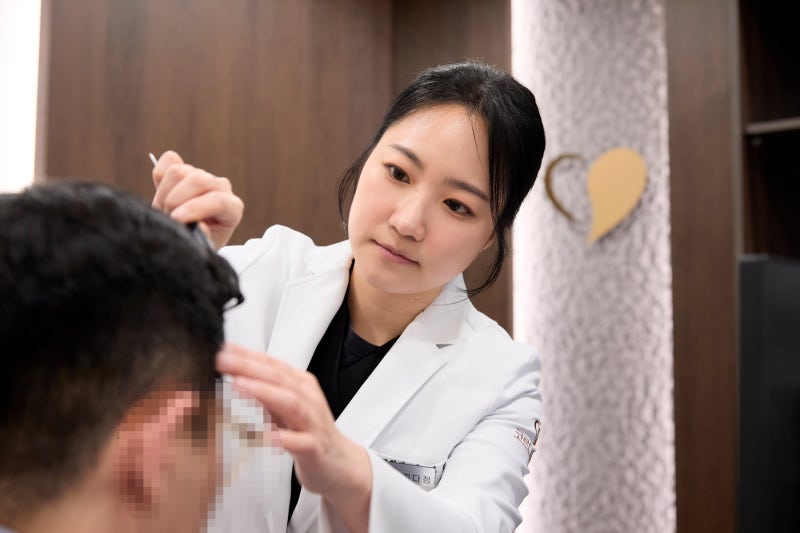
This was Dajeong Kim, Principal Physician of Cordia Clinic.
Thank you.
〈Q&A〉 Frequently Asked Questions
Question | Answer |
Q. If a new hair loss drug comes out, can I stop taking my current medication? | The effectiveness and safety of a new drug must be sufficiently confirmed first. For now, it is best not to discontinue existing treatments on your own. |
Q. Will adding scalp injection therapy help? | Some studies have shown positive results, but the level of evidence differs depending on the ingredient. Your hair loss status and response to existing treatment should be taken into account. |
Q. Can drug therapy be effective even when hair loss has progressed significantly? | Drug therapy may help maintain remaining hair or improve its thickness, but its effects are limited in areas where hair follicles have been completely lost. |
〈References〉
Lee J, Thanomkitti K, Tosti A. (2026). Evaluating current and emerging pharmacological treatment options for men with androgenetic alopecia. Expert Review of Clinical Pharmacology.
Original article on PubMed
DOI: 10.1080/17512433.2026.2761210
※ This paper is a narrative review that summarizes existing research and does not mean that the effects of new treatments have been confirmed. This article is intended to provide general medical information.
〈Cordia Clinic Reservation Guide〉
Cordia Clinic operates on a 100% appointment-only basis to allow for thorough consultations and individualized care. Please make a reservation by phone, KakaoTalk, or Naver before your visit.
〈Reservations and Inquiries〉
Phone: 02-568-8575
Please contact us via whichever method is most convenient for you, including KakaoTalk or Naver reservations.
〈Office Hours〉
Mon, Tue, Thu, Fri: 11:00 AM – 8:00 PM
Lunch break: 2:00 PM – 3:00 PM
Saturday: 10:00 AM – 4:00 PM
Saturday hours do not include a lunch break.
〈Directions〉
429 Seolleung-ro, Gangnam-gu, Seoul
6th Floor, KR Tower, Cordia Clinic
Exit 3 of Seolleung Station, the building with Burger King
#NewHairLossDrugs #LatestHairLossResearch #HairLossDrugDevelopment #AndrogeneticAlopecia #MaleHairLoss #HairLossTreatment #HairLossMedication #HairLossMedicationEffect #Finasteride #Dutasteride #Minoxidil #OralMinoxidil #InjectableFinasteride #Clascoterone #GT20029 #PP405 #HMI115 #HairLossInjections #ScalpInjectionTherapy #ExosomeHairLoss #ScalpExosome #ScalpPDRN #Polynucleotide #FollicleMiniaturization #HairThickness #HairDensity #EarlyHairLossTreatment #HairLossTreatmentDuration #SeolleungHairLoss #YeoksamHairLoss