2026-11-07
Can Amino Acid Infusions Cause Side Effects? What to Know Before Getting Armix Injection
Amino acid infusions are prescription drugs that can cause nausea, palpitations, injection-site pain, and rarely severe allergic reactions. Learn key precautions before receiving Armix Injection.
Hello, I'm Kim Da-jeong, Director of Cordia Clinic.

There are times when people consider an amino acid infusion because they can't eat properly or their nutritional status is poor.
Since amino acids are essential building blocks for making protein in the body, it's easy to assume that receiving them through an infusion carries no risk of side effects.
However, because amino acid infusions are prescription medications, they can cause side effects too.
Common reactions include nausea, palpitations, and discomfort at the injection site, and in rare cases, severe hypersensitivity reactions can also occur.
That said, not every patient experiences these symptoms.
Today, we'll look at the side effects of amino acid infusions and what to check to receive them safely.
1. What role do amino acid infusions play?
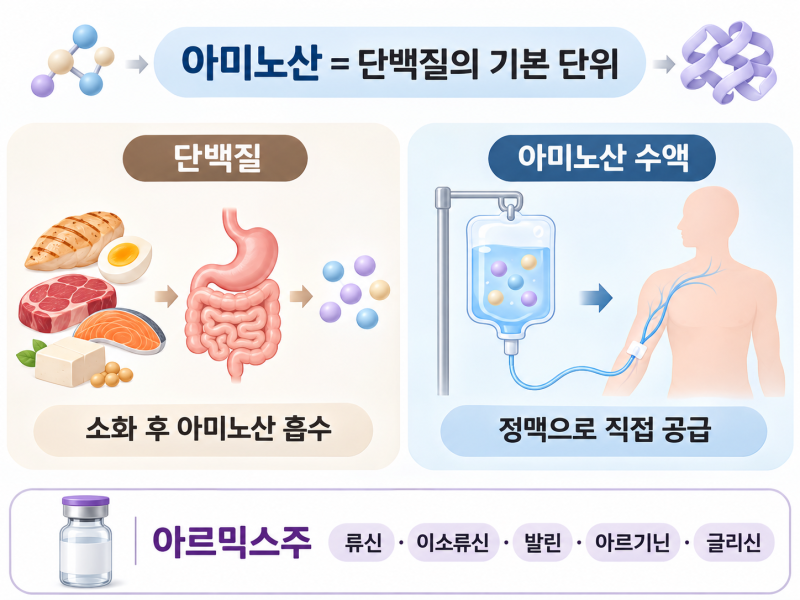
Amino acids are the basic units that make up protein.
In the body, they help maintain tissues such as muscle, skin, and hair, and are used to synthesize enzymes and some hormones.
Normally, protein from food is broken down during digestion and absorbed as amino acids.
By contrast, an amino acid infusion delivers amino acids directly into a vein, bypassing the digestive system.
Armix Injection, a representative product, contains a variety of amino acids, including leucine, isoleucine, valine, arginine, and glycine.
The Ministry of Food and Drug Safety has approved it for hypoproteinemia, poor nutritional status, and amino acid supplementation before and after surgery.
2. Side effects that may occur with amino acid infusions
① Nausea and vomiting
The approved labeling for Armix Injection states that nausea and vomiting may occur.
These symptoms can be affected by the infusion rate and the patient's physical condition.
In particular, infusing the solution too quickly can cause chills, vomiting, and other reactions, so it's important to maintain an appropriate rate.
② Palpitations and chest discomfort
Some patients may feel tightness in the chest or a rapid heartbeat.
The approved labeling for Armix Injection also lists palpitations, tachycardia, elevated blood pressure, and chest discomfort as adverse reactions.
If these symptoms appear, don't dismiss them as a temporary reaction; let your medical staff know immediately.
③ Injection-site pain and vein irritation
During an infusion, you may feel a stinging or aching sensation along the vein.
Amino acid solutions given intravenously can irritate blood vessels and, in some cases, cause phlebitis, redness at the injection site, or swelling.
If the injection site is severely painful or swollen, check for vessel irritation or fluid leaking out of the vein.
④ Allergies and hypersensitivity reactions
Rarely, hypersensitivity reactions such as rash or itching may occur.
Armix Injection contains sodium bisulfite as an additive, and patients sensitive to it may experience allergic reactions or asthma symptoms.
In severe cases, serious hypersensitivity reactions such as difficulty breathing or anaphylaxis can occur, so caution is required.
3. Why caution is needed if you have liver or kidney disease
Amino acids are metabolized in the body, and the nitrogenous waste produced in this process is mainly excreted through the kidneys.
Therefore, patients with severely impaired kidney function may have trouble excreting nitrogenous waste.
In addition, in severe liver disease, amino acid metabolism can be disrupted, raising the risk of elevated blood ammonia.
If you have heart failure or pulmonary edema, the volume of fluid delivered through the infusion can also become an issue.
The approved labeling for Armix Injection also lists severe renal impairment, hepatic coma, and certain patients with heart failure or pulmonary edema as contraindications.
Therefore, before receiving an infusion, it's important to check your underlying conditions, current medications, and overall health.
4. Is it better to receive amino acid infusions slowly?
The infusion rate is determined by the type and volume of the product and the patient's condition.
The approved labeling for Armix Injection also instructs that it be administered slowly into a vein.
Rapid infusion can cause chills, vomiting, and other reactions, and it may also increase the loss of amino acids through the kidneys.
So receiving an infusion faster does not make it more effective at supplying nutrition.
What matters is maintaining the dose and rate that are appropriate for the patient.
5. What to do if these symptoms appear during an infusion
If any of the following symptoms occur, notify your medical staff immediately.
Severe pain or swelling at the injection site
Persistent nausea or vomiting
Sudden palpitations or chest tightness
Widespread hives, or swelling of the face or lips
Difficulty breathing, severe dizziness, or a change in consciousness
If difficulty breathing or a severe hypersensitivity reaction is suspected, stop the infusion immediately and seek emergency evaluation.
6. Frequently asked questions
Q. Is it okay to get amino acid infusions often?
It is not an infusion that needs to be repeated on a fixed schedule. Whether you need one should be judged based on your actual nutritional status, food intake, and underlying conditions.
Q. Can healthy people also experience side effects?
Yes. Even people without underlying conditions can develop reactions at the injection site, nausea, or allergies.
Q. Can an amino acid infusion replace meals?
No. Amino acid infusions supply the components needed for protein synthesis, but they do not provide sufficient calories or all essential nutrients.
7. What matters most is confirming whether an infusion is actually needed
Amino acid infusions can help supply necessary amino acids to some patients with insufficient nutrient intake.
However, just because a nutrient is needed by the body doesn't mean it is free of side effects when given intravenously.
To use an amino acid infusion effectively, it's important to check the patient's nutritional status and underlying conditions, and to administer it at an appropriate dose and rate.
References
Ministry of Food and Drug Safety, Drug Information Integrated System. Armix Injection approved labeling and precautions for use.
Daehan Pharmaceutical Co. Armix Injection product information.
U.S. National Library of Medicine, DailyMed. Aminosyn II – Adverse Reactions and Precautions.
※ This article is provided for general medical information only. Whether to receive an infusion should be decided based on the patient's health status and the drug's approved labeling.
〈Cordia Clinic Appointment Guide〉
Cordia Clinic operates on a 100% appointment-only basis to allow for thorough consultations and individualized care. Please book by phone, KakaoTalk, or Naver before your visit.
〈Booking and Inquiries〉
Phone: 02-568-8575
Feel free to contact us via KakaoTalk, Naver booking, or any other convenient method.
〈Hours〉
Mon, Tue, Thu, Fri: 11:00 AM – 8:00 PM
Lunch break: 2:00 PM – 3:00 PM
Sat: 10:00 AM – 4:00 PM
We see patients on Saturdays without a lunch break.
〈Directions〉
429 Seolleung-ro, Gangnam-gu, Seoul
Cordia Clinic, 6th Floor, KR Tower
Exit 3 of Seolleung Station, Burger King building
#AminoAcidInfusion #AminoAcidInfusionSideEffects #ArmixInjection #ArmixInjectionSideEffects #AminoAcidInjection #AminoAcidBenefits #NutritionInfusion #NutritionInfusionSideEffects #NutrientInjection #ProteinInfusion #ProteinInjection #EssentialAminoAcids #AminoAcidSupplementation #NutritionalDeficiency #PoorNutritionalStatus #Hypoproteinemia #IVDripSideEffects #InfusionRate #IVVeinPain #Phlebitis #InfusionAllergy #InfusionNausea #InfusionPalpitations #InfusionPrecautions #IVTherapy #NutritionManagement #FatigueRecoveryDrip #SeolleungIVDrip #YeoksamIVDrip #CordiaClinic