2026-09-30
Hair Shedding After Applying Minoxidil: Is It Normal? | Hair Loss Treatment in Seolleung
Experiencing increased shedding after using minoxidil? Learn why the initial shedding phenomenon happens, how long it lasts, and when to consult a specialist for hair loss treatment in Seolleung, Seoul.

Hello.
I am Dr. Dajeong Kim, Chief Director of Cordia Clinic.
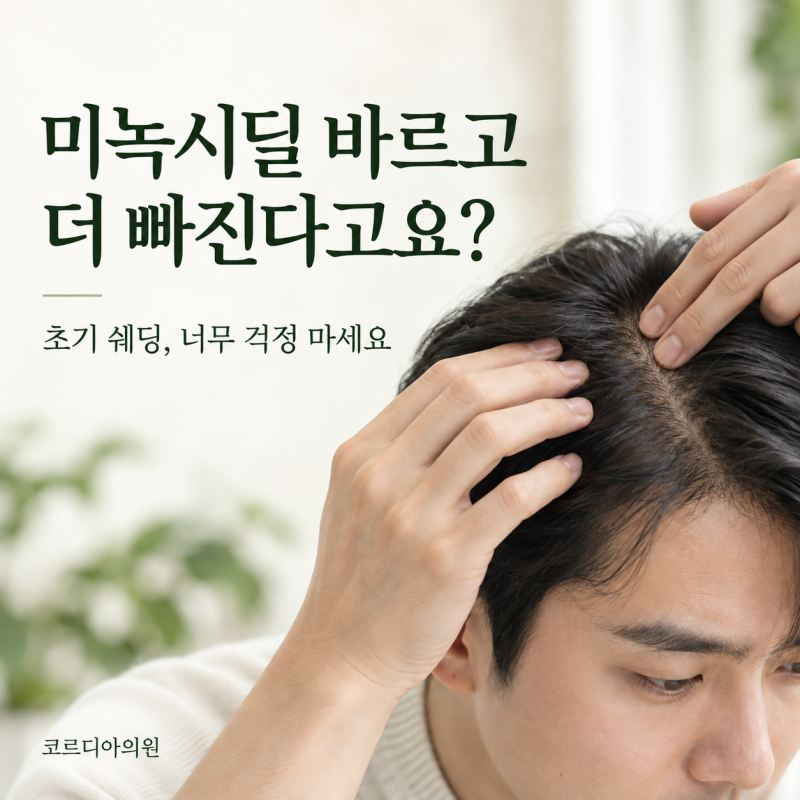
“I started applying minoxidil, but now I’m losing even more hair.”
“I used it to make my hair thicker—could it actually be worsening my hair loss?”
When you start treatment hoping to resolve hair loss only to see more strands collecting in the shower drain, it is natural to feel anxious about whether you should continue using it.
Every single strand feels precious, so hearing “just wait and see” rarely offers real peace of mind.
First and foremost, experiencing increased hair shedding in the early stages of minoxidil use does not mean your treatment has failed.
It may simply be a temporary phase known as the "shedding phenomenon," occurring as your hair transitions into a new growth cycle.
Today, I will explain why this shedding occurs, how it typically progresses, and when you should seek a professional medical consultation.
Why Does Hair Fall Out More After Applying Minoxidil?
Hair does not grow continuously from a single follicle throughout your life.
Instead, it cycles through repeated stages: the growing phase (anagen), the transitional phase (catagen), and the resting phase (telogen), after which it sheds and new hair begins to grow.
Minoxidil is known to stimulate follicles in the resting phase to enter the active growing phase. During this transition, older hairs nearing the end of their cycle fall out first, making it look as though you are losing more hair than usual.
In simple terms, as new anagen hairs push their way out, the shedding of older strands becomes noticeably apparent.
The British Association of Dermatologists also notes that when initiating minoxidil treatment, temporary shedding can occur as hair reaching the end of its life cycle is replaced by new growth.
Therefore, you do not need to assume the medication has damaged your hair follicles just because of an initial increase in shedding.
Is the Shedding Phenomenon Confirmed in Scientific Studies?
Yes. Recent studies have directly observed changes in hair shedding after using topical minoxidil.
A retrospective study published in 2025 followed male and female pattern hair loss patients over 24 weeks and reported a temporary increase in shedding around week 4 of treatment, which did not persist long-term.
A multicenter prospective cohort study published that same year similarly observed that the transient increase in shedding subsided after lasting about 2 to 6 weeks.
However, the timelines observed in these studies do not apply identically to everyone.
Rather than deciding "it's been X weeks, so it must be normal," it is crucial to monitor when you began treatment, how your shedding pattern changes, and whether you experience any scalp symptoms.
I See the Hair Falling Out, So Why Can't I See New Growth?
Falling strands are visible immediately.
In contrast, new hairs take time to break through the scalp surface, lengthen, and become thick enough to notice.
This is why during the early stages of treatment, you might only see strands coming out and fail to notice any new growth. For most patients, this is the most anxiety-inducing phase.
However, the full efficacy of minoxidil cannot be judged in just a few days or weeks. Evaluating visible changes requires observing progress over several months.
Giving new hair time to grow is an essential part of the treatment process.
Of course, experiencing shedding does not automatically guarantee full, dense hair regrowth later on. Conversely, the absence of shedding does not mean the medication isn’t working.
Please do not prejudge your ultimate treatment outcome solely on the presence or severity of the shedding phenomenon.
Should I Just Endure It and Keep Applying It?
If the shedding aligns with typical initial shedding, you can continue following your prescribed instructions and monitor your progress.
However, not all hair loss occurring after starting minoxidil can be attributed to the shedding phenomenon.
Please seek a professional medical consultation if you notice any of the following:
Hair loss continues to increase without showing any signs of reduction
Shedding persists for an unusually long time or hair density noticeably thins
Sudden, round, patchy bald spots appear in specific areas
The scalp becomes severely red, itchy, or irritated
In these cases, an evaluation is needed to check for scalp irritation or other underlying causes of hair loss.
When visiting the clinic, bringing information regarding the product name, concentration, application amount and frequency, and start date will greatly help the assessment.
Rather than adjusting the dose on your own or constantly stopping and restarting the treatment out of anxiety, consult a specialist first to see if your current symptoms fall within the expected range.
Track Changes Over Time Rather Than Counting Daily Shedding
Counting every lost strand each day will only leave you feeling anxious over minor daily fluctuations.
If you want to track your progress, take photos after completely drying your hair under the same lighting, at the exact same angle, and with the same parting.
Comparing these with your baseline photos will help you objectively assess shifts in hair thickness, density, and scalp visibility.
At Cordia Clinic, we evaluate your scalp and hair condition, review your current regimen and recent changes, and consult on the most appropriate treatment direction.
Rather than offering a generic "don't worry, just wait," we believe it is vital for you to understand why you can wait and what signs signal the need for a re-evaluation.
Don't Let the Initial Shedding Overshadow the Treatment's Potential
It is entirely natural to feel worried when you see your hair falling out.
However, the early shedding seen with minoxidil is often just a temporary phase occurring as new hairs prepare to grow.
Immediate visible shedding does not equal treatment failure. Give your new hair time to emerge, and monitor the progress patiently.
If you are experiencing increased hair loss after starting minoxidil in the Seolleung, Yeoksam, or Daechi area, please feel free to visit Cordia Clinic with your current product and baseline scalp photos for a thorough consultation.
We are here to address your concerns and help set your mind at ease.
Thank you. Warmly, Dr. Dajeong Kim, Chief Director of Cordia Clinic.
〈 Cordia Clinic Reservation Information 〉
Cordia Clinic operates entirely by appointment to ensure thorough consultations and individualized care. Please reserve your visit in advance by phone, KakaoTalk, or Naver Booking.
〈 Reservations & Inquiries 〉
Phone: 02-568-8575
Inquiries are also welcome via KakaoTalk and Naver.
〈 Clinic Hours 〉
Mon, Tue, Thu, Fri: 11:00 AM – 8:00 PM
Lunch Break: 2:00 PM – 3:00 PM
Saturday: 10:00 AM – 4:00 PM
No lunch break on Saturdays.
〈 Location 〉
6F KR Tower, 429 Seolleung-ro, Gangnam-gu, Seoul, Republic of Korea
Cordia Clinic (Exit 3 of Seolleung Station, Burger King building)
Frequently Asked Questions
Why does hair fall out more after applying minoxidil?
This is due to a temporary shedding phenomenon where older hairs make way for new growth. Minoxidil stimulates resting follicles to transition into the active growing phase. During this process, telogen hairs that have reached the end of their cycle shed first, causing a temporary increase in shedding.
How long does the minoxidil shedding phenomenon usually last?
Clinical studies show that shedding typically lasts about 2 to 6 weeks before subsiding. While prospective cohort studies published in 2025 observe an initial spike in shedding followed by stabilization, the timeline varies by individual, so it is important to monitor your personal start date and scalp condition.
Does experiencing shedding mean my hair is guaranteed to grow thicker?
Not necessarily. Experiencing shedding does not guarantee that your hair will become noticeably thicker, nor does the absence of shedding indicate that the treatment is ineffective. The final outcome cannot be determined solely by the presence or severity of the shedding phenomenon.
What symptoms during minoxidil use require an immediate medical consultation?
You should see a doctor if shedding progressively worsens without subsiding, or if signs of scalp irritation appear. Symptoms like severe hair thinning, sudden circular bald spots, or significant scalp redness, itching, and burning require evaluation for scalp disorders or other hair loss causes.
How can I track and monitor my minoxidil treatment progress at home?
Taking regular comparison photos under consistent conditions is the best approach. After drying your hair completely, take photos under the same lighting, at the same angle, and with the same parting. Comparing these photos over time helps you objectively assess changes in hair thickness, density, and scalp visibility.