2026-11-02
More Short Hairs: New Growth or Thinning Hair? | Hair Loss Clinic Near Seolleung Station
Short hairs around the hairline or crown may be new growth or hair that has thinned due to hair loss. Learn how to tell them apart by checking thickness, growth pattern, and surrounding hair density.
Hello, this is Kim Dajeong, Medical Director of Cordia Clinic.
Sometimes, while looking in the mirror, you may notice more short, wispy hairs around your forehead or crown.

“Is my hair starting to grow back?”
“Or is my hair getting thinner because hair loss is progressing?”
To answer upfront: those short hairs may be newly growing hair, but they may also be thinner hair caused by hair loss.
What matters is checking not just the length of the hair, but also its thickness, growth pattern, and the condition of the surrounding hair.
Today, we will look at why more short hairs appear and how to tell them apart from early signs of hair loss.
1. Why do more short hairs appear?
Hair goes through repeating cycles of growth (anagen), regression (catagen), and rest (telogen).
After a hair enters the resting phase and falls out, a new growth phase begins, and short hairs start to grow.
Short hairs can appear even during this normal hair growth cycle.
They are also commonly seen during recovery from telogen effluvium, a temporary form of hair shedding triggered by childbirth, rapid weight loss, or illness.
Short hairs may also become noticeable after using hair loss medication, as new hair begins to grow.
Therefore, an increase in short hairs alone does not mean that hair loss is progressing.
2. Can more short hairs appear when hair loss is progressing?
Yes. In androgenetic alopecia (male and female pattern hair loss), the number of short, fine hairs can also increase.
This is related to “follicular miniaturization.”
Under the influence of genetic predisposition and hormones, hair follicles gradually shrink. As a result, thick hairs become thinner and the growth phase becomes shorter.

As a result, hair may not grow long or thick enough and may remain short and fine.
A systematic review published in the Journal of Clinical Medicine in 2024 identified uneven hair thickness and an increase in fine hairs as key features of patients with androgenetic alopecia.
In other words, what matters more than the number of short hairs is whether the proportion of thick hairs is decreasing.
3. How do you tell newly growing hair from thinning hair?
Newly growing hair is short but has a relatively healthy thickness, and it can be seen getting longer over time.
In contrast, hairs affected by follicular miniaturization are noticeably thinner and shorter than the surrounding hair and may appear lighter in color.
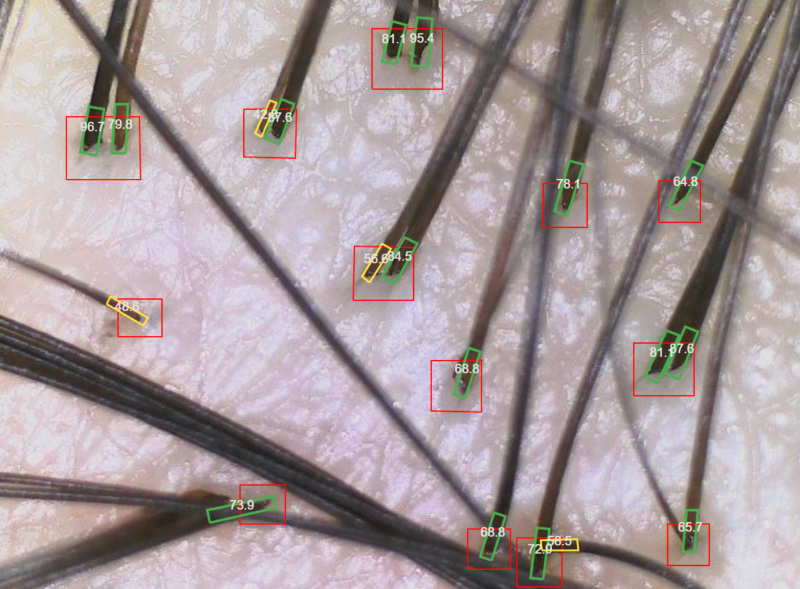
Also, when observed under a dermoscope, thick and thin hairs may appear mixed together irregularly.

However, newly emerging hair can also be fine, and new hair can grow from follicles that are undergoing miniaturization, so appearance alone cannot fully distinguish the two.
Normal short hairs also exist along the hairline.
Therefore, checking hair thickness, density, and distribution together using scalp dermoscopy is helpful.
4. How should you manage an increase in short hairs?
If you notice more short hairs, it is a good idea to take photos of the same area at regular intervals and compare the changes.
In particular, if short hairs increase around the crown or parting while overall hair density decreases, the possibility of pattern hair loss should be checked.
On the other hand, if short hairs increase because hair that had shed heavily is growing back, it may be part of the recovery process.
Also, frequent use of heat styling tools or strong friction can break hair partway along its length, making it look like short hairs.
5. Frequently asked questions
Q. I have noticed more short hairs after using minoxidil. Is it working?
Minoxidil is a medication that promotes hair growth. If new hair is seen after use, it may be a positive change. However, treatment effects should be evaluated not only by the number of short hairs but also by changes in hair density and thickness.
Q. Can short hairs become thicker?
Recovering hair can grow longer, and its thickness may improve. On the other hand, miniaturized hair may need treatment depending on the cause and extent of hair loss.
Q. Does having many short hairs along the hairline also mean hair loss?
Not necessarily. Short, fine hairs can naturally exist along the hairline. However, if the hairline gradually recedes or the surrounding hair also becomes thinner, we recommend a consultation.
6. What matters is changes in your hair, not the number of short hairs
Short hairs can be a positive sign of new growth, or they can be a change that appears as hair loss progresses.
Therefore, rather than feeling reassured or worried simply because there are many short hairs, it is important to check changes in hair thickness and overall density.
Accurately distinguishing whether short hairs are newly growing or thinning hair helps you understand your current hair condition and decide on the appropriate treatment direction.
References
Trichoscopy of Androgenetic Alopecia: A Systematic Review. Journal of Clinical Medicine. 2024.
Trichoscopic Findings of Hair Loss in Koreans. Annals of Dermatology. 2015.
DermNet. Trichoscopy of generalised noncicatricial hair loss.
American Academy of Dermatology. Hair loss: Signs and symptoms.
※ This article is provided for general medical information only. An accurate diagnosis of your specific hair loss type and hair condition requires evaluation by a medical professional.
〈Cordia Clinic Appointment Information〉
Cordia Clinic operates on a 100% appointment basis to allow sufficient consultation and individualized care. Please make a reservation by phone, KakaoTalk, or Naver before your visit.
〈Appointments & Inquiries〉
Phone: 02-568-8575
Please contact us through whichever method is most convenient for you, including phone, KakaoTalk, or Naver booking.
〈Opening Hours〉
Mon, Tue, Thu, Fri: 11:00 AM – 8:00 PM
Lunch break: 2:00 PM – 3:00 PM
Saturday: 10:00 AM – 4:00 PM
We see patients on Saturdays without a lunch break.
〈Directions〉
429 Seolleung-ro, Gangnam-gu, Seoul
6th Floor, KR Tower, Cordia Clinic
Exit 3 of Seolleung Station, the Burger King building
#ShortHairs #ShortHairGrowth #NewHairGrowth #HairMiniaturization #FollicularMiniaturization #HairThickness #HairDensity #ThinHair #HairThinning #PartingHairLoss #HairlineHairLoss #CrownHairLoss #FemalePatternHairLoss #MalePatternHairLoss #EarlyHairLossSigns #HairLossProgression #HairLossRecovery #TelogenEffluvium #HairLossMedication #MinoxidilResults #MinoxidilShortHairs #Dermoscopy #ScalpDiagnosis #HairLossCauses #HairLossTreatment #SeolleungHairLoss #YeoksamHairLoss #DaechiHairLoss