2026-11-06
No Results After 1–2 Months of Hair Loss Treatment? When Will My Hair Start to Grow? | Yeoksam-dong Hair Loss Clinic
Hair loss treatment usually takes months to show results because hair grows slowly. Learn why effects appear late and how to evaluate progress at 1–2, 3–6, and 6–12 months.
Hello, I'm Dr. Dajeong Kim, Director of Cordia Clinic.
Some people feel worried after starting hair loss treatment, because one or two months have passed without any noticeable change.
“I've been treated for two months, and my hair volume is still the same.”
“Is hair loss treatment just not working for me?”
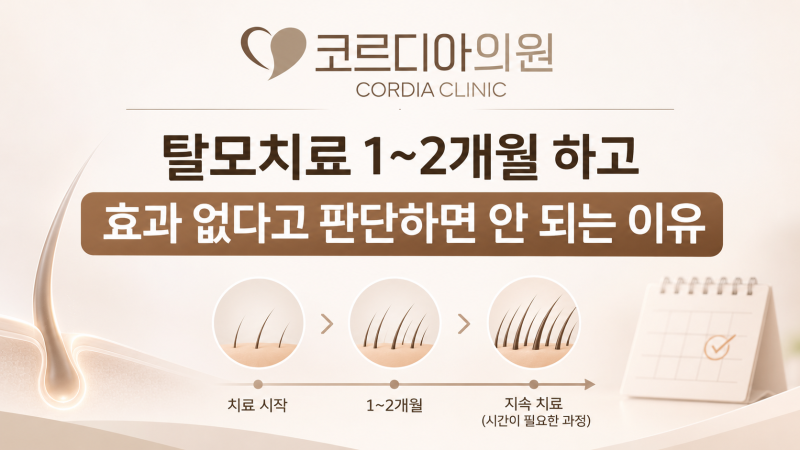
To answer up front, it is difficult to conclude that hair loss treatment is ineffective just one to two months after starting it.
Hair grows slowly according to its growth cycle, so it may take several months for treatment effects to show up as actual changes in hair thickness and density.
Today, let's look at why hair loss treatment results appear late and when it is appropriate to evaluate them.
1. Why Hair Loss Treatment Results Appear Late
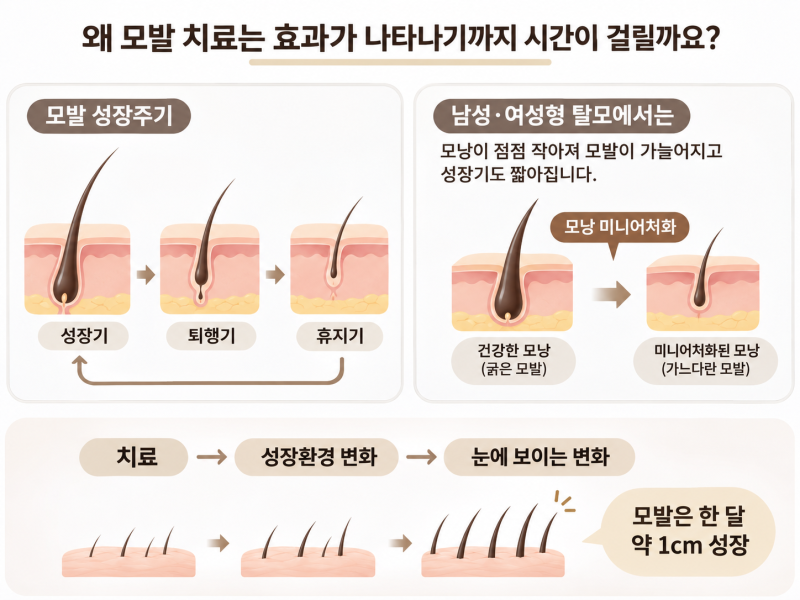
Hair cycles through the anagen (growth), catagen (regression), and telogen (resting) phases.
The anagen phase of scalp hair can last for several years, and hair that has passed through the telogen phase falls out and enters a new growth cycle.
In male and female pattern hair loss, hair follicles gradually shrink, the anagen phase becomes shorter, and hair becomes thinner.
Hair loss treatment aims to slow these changes or promote hair growth.
However, a change in the follicle's growth environment and hair growing enough to be visible to the eye are two different processes.
Scalp hair generally grows about 1 cm per month, so even when new hair starts to grow, it takes time to reach sufficient length and thickness.
2. When Do Hair Loss Medications Start to Work?
Even the most common hair loss medications, finasteride and minoxidil, require a certain period before their effects can be confirmed.
The U.S. FDA's prescribing information for finasteride generally states that treatment effects can be observed only after taking the medication consistently for at least three months.
The American Academy of Dermatology (AAD) also advises that it may take about 6 to 12 months to fully evaluate the effects of minoxidil.
In other words, the fact that hair volume has not increased significantly after two months of treatment does not mean the medication is not working.
In addition, in the early stages of treatment, minoxidil can temporarily cause a large amount of telogen hair to fall out, a phenomenon known as shedding.
This is usually a temporary change, but if the amount of hair loss keeps increasing, it is necessary to check for other possible causes.
3. Does Scalp Injection Therapy Also Take Time?
As with scalp injection therapy, rather than expecting hair to thicken right after the procedure, changes should be evaluated over a set period of time.
Scalp injection therapies using botulinum toxin, PRP, and regenerative ingredients are being studied mainly for their effects on the environment around the hair follicles and on hair growth.
Some clinical studies have reported positive results, with improvements in hair thickness and density after repeated treatments.
However, the level of evidence differs depending on the ingredient and treatment method, and a standardized timeline for judging the effects of injection therapy has not been firmly established.
Therefore, even when combined with medication, it is important to objectively compare hair condition before and after treatment.
4. How Is the Effect of Hair Loss Treatment Judged?
In my hair loss consultations, I focus less on simply how much new hair has grown and more on how the thickness and density of existing hair have changed.
This is because stopping further hair loss and maintaining your current hair condition can also be an important treatment outcome.
In typical pattern hair loss treatment, progress can be evaluated as follows.
1–2 months: Check how well you tolerate the treatment, any side effects, and changes in the amount of hair shedding
3–6 months: Evaluate early changes in hair thickness and density
6–12 months: Comprehensive evaluation of treatment results and maintenance plan
These are general reference points, however, and the timing varies depending on the type of hair loss and the treatment method.
5. When Your Treatment Should Be Reassessed
Waiting for treatment to work is different from simply continuing the same treatment no matter what.
If hair loss worsens rapidly, new patches of alopecia areata appear, or severe inflammation or pain develops on the scalp, you should seek an early consultation.
Likewise, if you experience medication side effects, appropriate adjustments are needed regardless of how long you have been on treatment.
6. Frequently Asked Questions
Q. If I've been taking hair loss medication for two months with no change, should I switch?
Not necessarily. If there are no side effects and the diagnosis is appropriate, you can evaluate the effect after securing a sufficient treatment period.
Q. Can treatment still be effective even if no new hair is growing?
Yes. Especially in pattern hair loss, slowing progression and maintaining existing hair alone can be a meaningful treatment outcome.
7. Consistent Monitoring Is Key in Hair Loss Treatment
In many cases, it is difficult to judge the results of hair loss treatment in a short period of time.
In particular, male and female pattern hair loss should be managed over the long term, taking into account the hair growth cycle and the progression characteristics of the condition.
Even if there is no noticeable change one to two months after starting treatment, please don't be too discouraged.
What matters is not simply completing a treatment period, but receiving treatment suited to you while objectively tracking changes in your hair.
References
American Academy of Dermatology. Hair loss: Diagnosis and treatment.
American Academy of Dermatology. Thinning hair and hair loss: Could it be female pattern hair loss?
U.S. FDA. PROPECIA (finasteride) Prescribing Information.
DermNet. Female pattern hair loss.
※ This article is intended to provide general medical information. Actual treatment effects and evaluation timing vary depending on the type of hair loss and the individual's condition.
〈Cordia Clinic Reservation Information〉
Cordia Clinic is 100% appointment-based to ensure sufficient consultation and individualized care. Please make a reservation by phone, KakaoTalk, or Naver before your visit.
〈Booking and Inquiries〉
Phone: 02-568-8575
Feel free to contact us via KakaoTalk, Naver booking, or any other convenient method.
〈Office Hours〉
Mon, Tue, Thu, Fri: 11:00 AM – 8:00 PM
Lunch break: 2:00 PM – 3:00 PM
Saturday: 10:00 AM – 4:00 PM
On Saturdays, we see patients without a lunch break.
〈Directions〉
429 Seolleung-ro, Gangnam-gu, Seoul
Cordia Clinic, 6th Floor, KR Tower
Seolleung Station, Exit 3 (Burger King building)
#HairLossTreatment #HairLossTreatmentResults #HairLossTreatmentDuration #HairLossTreatmentReview #WhenDoesHairLossTreatmentWork #HairLossMedicationEffects #HairLossMedicationDuration #HairLossMedication3Months #HairLossMedication6Months #WhenDoHairLossMedsWork #MinoxidilResults #FinasterideResults #DutasterideResults #MinoxidilShedding #HairGrowthCycle #HairGrowthPhase #TelogenEffluvium #HairThickness #HairDensity #FollicularMiniaturization #ScalpInjectionTherapy #HairLossInjectionResults #ScalpBotox #HairLossTreatmentProgress #EarlyHairLossSymptoms #CrownHairLoss #MalePatternHairLoss #FemalePatternHairLoss #SeolleungHairLoss #YeoksamHairLoss