2026-09-12
Why Is My Hair Part Widening? Early Symptoms of Female Pattern Hair Loss
Discover why your hair part may be widening, the early signs of female pattern hair loss (FPHL), diagnostic methods, and evidence-based treatments like minoxidil and antiandrogens to protect your density early on at Cordia Clinic in Gangnam, Seoul, Korea.
If your hairline remains unchanged but your part is progressively widening, it may be an early sign of female pattern hair loss. Here is an overview of the causes, diagnostic methods, and realistic expectations from treatment.
The width of the hair part is evaluated during a clinical consultation by comparing the crown to the back of the head. This is an informational image provided by the clinic.
What Does a Widening Part Mean?
A hair part that appears increasingly wider is a hallmark early symptom of female pattern hair loss (FPHL, or female androgenetic alopecia). It does not happen because hair falls out all at once, but rather because the overall density at the crown and frontal scalp diminishes, making the part line more visible.
Often colloquially referred to as "widening part hair loss," it typically preserves the anterior hairline, unlike male pattern baldness. It is the most common form of hair loss in women, and its prevalence increases with age.
What Causes Female Pattern Hair Loss?
The exact cause of female pattern hair loss is multifactorial and not yet completely understood. It is considered to result from an interplay of genetic predisposition along with hormonal and non-hormonal factors.
The hair growth cycle (anagen phase) shortens, and hair follicles gradually shrink (miniaturization), causing thick terminal hairs to be replaced by thinner, shorter vellus-like hairs.
Although male hormones (androgens) are involved, the majority of women suffering from FPHL show completely normal hormone levels on blood tests.
How Is It Diagnosed in the Clinic?
In most cases, diagnosis is established through a thorough medical history and physical examination. The clinician compares the width of the part on the crown with the density at the back of the head (occiput). A wider part at the crown indicates female pattern hair loss and helps differentiate it from chronic telogen effluvium, which presents with diffuse, uniform shedding across the entire scalp.
Dermoscopy (scalp trichoscopy) is utilized to detect early microscopic changes that are not easily noticeable to the naked eye.
If necessary, hair density measurements or a scalp biopsy may be performed. Blood tests for hormones are generally indicated only when concurrent signs such as hirsutism or irregular menstruation are present; they are not required for every patient.
What to Expect from Hair Loss Treatment
Treatments for female pattern hair loss are significantly more effective at halting progression than at dramatically restoring lost density.
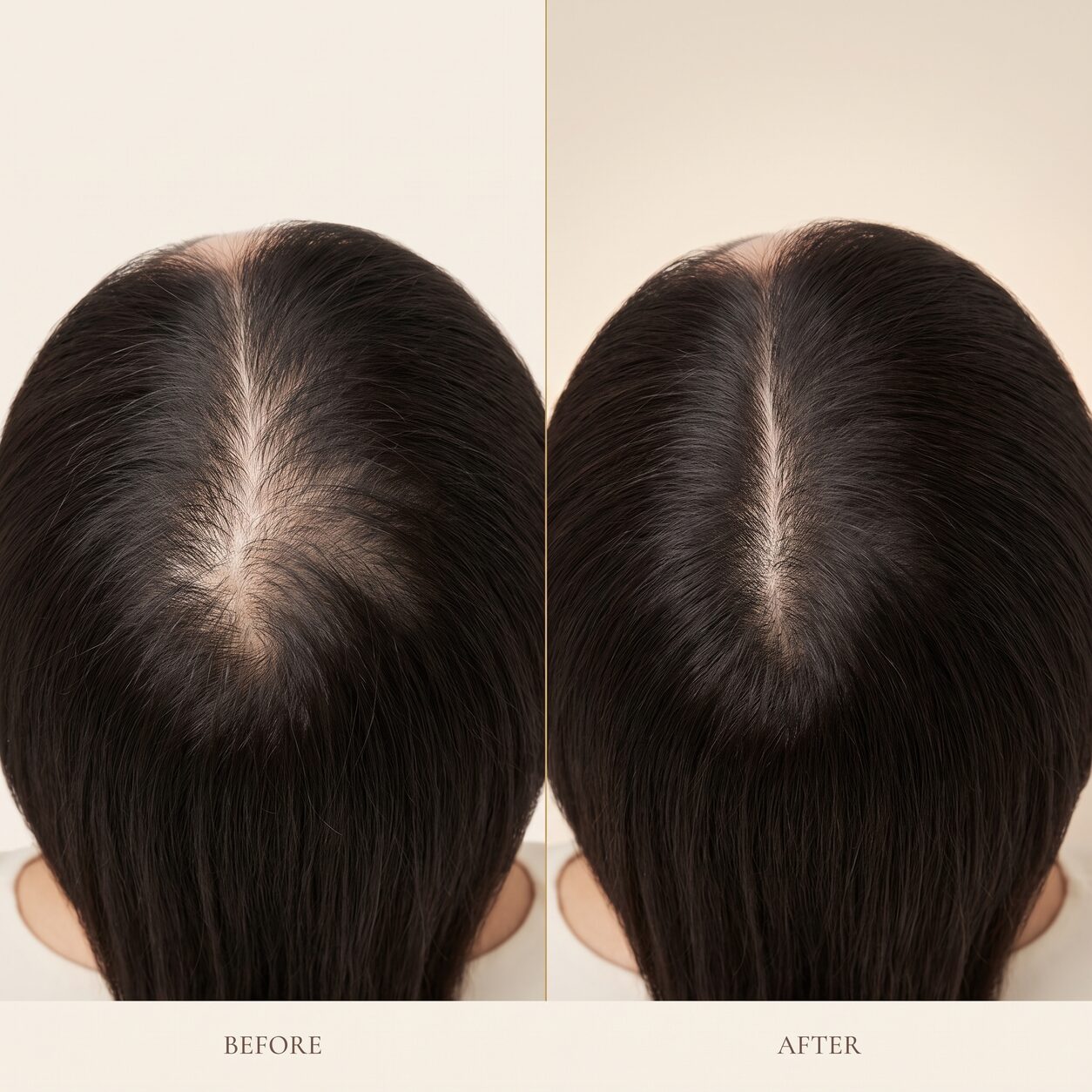
This is an AI-generated illustration demonstrating changes in hair part width before and after treatment. It does not represent an actual patient or clinical case; individual results vary and specific outcomes cannot be guaranteed.
· First-line: Topical Minoxidil — In clinical trials for the 2% formulation, an average increase of 15–33% in hair count was reported compared to placebo. It takes at least 12 months to assess full clinical efficacy, and discontinuation may result in regression to pre-treatment levels.
· Second-line: Oral Antiandrogens (Finasteride, Dutasteride, Spironolactone) — Medications that reduce the action of male hormones. An open-label study (87 patients, finasteride 5 mg daily for 12 months) reported improved density and thickness in up to 80% of participants. Conversely, a placebo-controlled trial of 137 postmenopausal women using 1 mg daily showed no significant benefit. Individual responses vary greatly, and larger studies are needed; evidence for dutasteride and spironolactone is largely based on smaller observational reports.
· Hair Transplantation — A surgical approach to enhance density by transferring donor hair follicles from the back of the head. It is considered in cases of extensive hair loss that have stabilized on medical therapy and where donor supply is adequate (usually in patients aged 25 or older). However, women often lack sufficient donor density, transient shedding ("shock loss") can make the area look thinner immediately after surgery, and medical maintenance therapy must continue post-transplant.
Options like PRP, growth factors, microneedling, and low-level laser therapy (LLLT) are adjunct therapies that cannot replace primary medical treatment, and their long-term efficacy remains to be fully clarified. High-quality clinical trials across female pattern hair loss treatments remain relatively limited.
Potential Side Effects and Precautions
The following adverse reactions may occur during treatment:
· Minoxidil — A temporary increase in shedding (dread shed) during the first few months, scalp irritation, contact dermatitis, or facial hypertrichosis (unwanted fine hair growth).
· Finasteride — Breast tenderness, changes in libido, headache, dizziness, menstrual irregularities, or increased body hair.
· Spironolactone — Orthostatic hypotension (dizziness upon standing), electrolyte imbalances (such as hyperkalemia), menstrual irregularity, fatigue, urticaria, breast tenderness, or altered laboratory values. Blood pressure and serum electrolytes should be monitored during the initial months.
Important Considerations Before Starting
· Finasteride and dutasteride are strictly contraindicated during pregnancy and breastfeeding due to the risk of feminization of a male fetus; strict contraception is mandatory for women of childbearing potential.
· Finasteride, dutasteride, and spironolactone are not FDA-approved specifically for female pattern hair loss (off-label use), and prescription suitability must be determined by a physician during consultation.
When Should You Consult a Doctor About Crown Thinning?
A medical evaluation is recommended if:
· Your part appears wider than before, or density at the crown and front is gradually decreasing even without excessive daily shedding
· Increased shedding has continued unabated for several months — other underlying causes should be investigated
Hair loss can substantially impact self-esteem and quality of life. Because therapeutic intervention is far more effective at preserving existing hair than regenerating lost follicles, early consultation during mild stages yields the best outcomes.

The treatment plan is determined after evaluating the part width and scalp condition. This is an informational image provided by the clinic and does not represent before-and-after procedural results.
Frequently Asked Questions
Q. Does a wider part always mean female pattern hair loss?
No. If you experience intense shedding while frontal and vertex density remains relatively stable, telogen effluvium is more likely. Postpartum shedding or diffuse alopecia areata can also look similar, which requires professional differentiation.
Q. What happens if I stop using minoxidil?
Any hair gained or maintained through treatment will likely shed within 4 to 6 months. Minoxidil requires continuous, indefinite use; please consult your physician before discontinuing.
Q. Can I take oral hair loss medications if I am planning to become pregnant?
No. Finasteride and dutasteride are contraindicated in pregnancy and lactation. Other oral antiandrogens, such as spironolactone, are also contraindicated during pregnancy due to fetal risks. Even topical minoxidil requires careful medical assessment during pregnancy. Please inform your doctor in advance if you plan to conceive.
Consultation & Appointment Details
Phone Inquiries / Reservations | 02-568-8575The optimal time for a consultation is when you first notice thinning or a loss of density. Treatment costs are provided during the consultation. |
Clinic Hours | Mon, Tue, Thu, Fri: 11:00 AM – 8:00 PM (Lunch break: 2:00 PM – 3:00 PM) Saturday: 10:00 AM – 4:00 PM Registration closes — Weekdays: 7:00 PM · Saturday: 3:00 PM Closed — Wednesday, Sunday, and Public Holidays |
Location | 6th Floor, KR Tower, 429 Seolleung-ro, Gangnam-gu, Seoul (Yeoksam-dong)100m from Seolleung Station Exit 3 · 1-minute walk |
References
· Ramos PM, Miot HA. Female Pattern Hair Loss: a clinical and pathophysiological review. An Bras Dermatol. 2015;90(4):529–43. (PMID 26375223)
· Fabbrocini G, Cantelli M, Masarà A, Annunziata MC, Marasca C, Cacciapuoti S. Female pattern hair loss: A clinical, pathophysiologic, and therapeutic review. Int J Womens Dermatol. 2018;4(4):203–211. (PMID 30627618)
· Singal A, Sonthalia S, Verma P. Female pattern hair loss. Indian J Dermatol Venereol Leprol. 2013;79(5):626–40. (PMID 23974580)
· Bertoli MJ, Sadoughifar R, Schwartz RA, Lotti TM, Janniger CK. Female pattern hair loss: A comprehensive review. Dermatol Ther. 2020;33(6):e14055. (PMID 32700775)
Of the four studies, Bertoli 2020 was referenced based on the abstract. This article provides general medical information and does not substitute for a clinical evaluation. Individual responses to treatment vary, and prescription decisions are made during professional medical consultations.
#FemalePatternHairLoss #WideningPart #CrownHairLoss #EarlyFemaleHairLoss #FPHL #FemaleAndrogeneticAlopecia #ChronicTelogenEffluvium #Trichoscopy #Dermoscopy #Minoxidil #Finasteride #Spironolactone #SeolleungHairLoss #YeoksamHairLoss #CordiaClinic