2026-10-15
Why Does Scalp Injection Pain Feel Different from Person to Person? Causes of Scalp Injection Pain and How to Ease It | Cordia Clinic, Seolleung Station Hair Loss Treatment
Explains why scalp injection pain varies from person to person, including nerve distribution, needle gauge, injection depth and speed, and evidence-based ways to reduce discomfort.
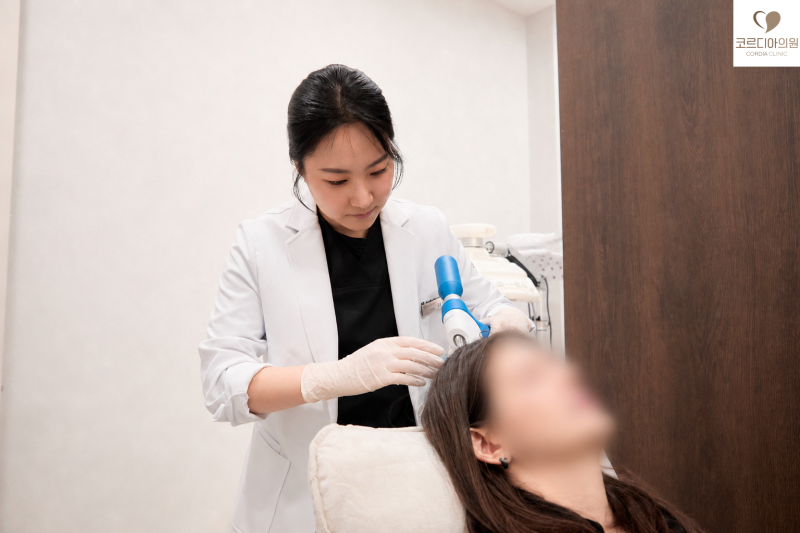
Hello. I am Dajeong Kim, Director of Cordia Clinic.
When performing scalp injections, the level of pain varies widely from patient to patient. This time, we'd like to talk about scalp injection pain.

Hair loss injection pain: why does it feel different for everyone? A scale runs from 'less pain' to 'more pain' beside a scalp injection.
"Do scalp injections hurt a lot?"
"My friend said it didn't hurt much, so why does it hurt so much for me?"
"It's the same scalp injection, so is there a reason why some days it's fine and other days it stings so much?"
These are questions that people considering scalp injections for hair loss treatment often ask.
Scalp injections include a range of procedures, from localized steroid injections used to treat alopecia areata to botulinum toxin and PRP, which are being studied as adjunct treatments for hair loss.
Because these treatments require delivering medication into the scalp, pain can occur.
However, there is something interesting here.
Even with the same type of injection, some people feel only a mild prick, while others experience quite intense pain.
Even the same person may not feel the same level of pain every time when receiving the same procedure repeatedly.
So why does scalp injection pain feel different from person to person?
To put it simply, scalp injection pain is the result of multiple factors working together. These include individual pain sensitivity, the nerve distribution of the scalp, the condition of the skin and tissue, the characteristics of the needle, injection depth and speed, the properties of the drug, and stress and previous procedure experience.
Various methods for reducing pain are also being studied.
In particular, research has shown that cooling, vibration stimulation, and local anesthesia may help relieve pain during scalp injections.
Today, we'll look at the scientific principles behind scalp injection pain, why pain varies among individuals, and the pain-reducing methods confirmed in clinical research, along with precautions.
1. Why do scalp injections hurt?
The scalp is a tissue richly supplied with blood vessels and sensory nerves, as well as the hair follicles that produce hair.
Nociceptors and the nervous system are involved in the process by which we perceive pain.
Nociceptors are the endings of sensory nerves that detect tissue damage or potentially harmful stimuli.
When a needle passes through the skin, a mechanical stimulus occurs.
When this stimulus activates sensory nerves, the signal travels through the spinal cord and brainstem, among other pathways, and is perceived as pain in the brain.
However, pain from a scalp injection does not occur only when the needle goes in.
It can be broken down into three stages.
① When the needle passes through the skin
As the needle penetrates the skin, nociceptors may be stimulated.
At this point, you may feel a sharp prick or a stinging sensation.
② When the drug enters the tissue
When medication enters the scalp tissue, the surrounding tissue may stretch or pressure may increase.
This process can sometimes cause a heavy or achy pain.
③ When the drug itself irritates the tissue
Depending on the concentration, pH, osmolarity, viscosity, and additives of the injected drug, irritation of the tissue may occur.
Therefore, there are cases where the needle insertion didn't hurt much, but the pain becomes more severe the moment the drug is injected.
Scalp injection pain is a phenomenon in which the stimulus from the needle, changes in tissue caused by drug injection, and the properties of the drug itself all contribute together.
2. The sensory nerve distribution differs by area of the scalp
Not the entire head is sensed by the same nerves.
The front, back, and sides of the scalp are each supplied by different sensory nerves.
Representative nerves are as follows:
Scalp area | Main sensory nerves |
Forehead and anterior scalp | Supraorbital and supratrochlear nerves |
Temporal region and around the ears | Auriculotemporal nerve, zygomaticotemporal nerve, etc. |
Occipital region (back of the head) | Greater occipital nerve, lesser occipital nerve, etc. |
Part of the crown | An area where the anterior and posterior sensory nerve territories overlap |
As such, the pathways and distribution of sensory nerves differ depending on the anatomical area of the scalp.
Therefore, pain patterns may vary depending on the injection site.
However, there is an important caveat here.
It cannot be universally stated that "the front hairline always hurts more" or that "the crown doesn't hurt because it has fewer nerves."
This is because there are differences depending on each person's nerve distribution, scalp thickness, and injection technique.
Also, even within the same area, pain can change if the injection depth or amount of drug varies.
Scalp injection pain is not determined simply by where the injection is given. Anatomical structure and injection technique must be considered together.
3. Why people feel pain to different degrees
Even when subjected to the same stimulus, the degree of pain people feel differs.
This cannot be explained simply as a matter of having a good or bad tolerance.
This is because pain is a complex sensory and emotional experience in which signals originating in peripheral nerves are processed in the brain.
Factors that may affect pain include the following:
① Pain threshold and pain sensitivity
Pain threshold refers to the level at which a stimulus begins to be perceived as pain.
There are individual differences in pain sensitivity.
However, the pain threshold does not remain constant in all situations.
It can change depending on physical condition, the surrounding environment, and other factors.
② Previous pain experience
If someone has experienced intense pain from an injection before, they may become more anxious before the next procedure.
Conversely, if the procedure went more comfortably than expected, anxiety about the next one may decrease.
③ Tension and anxiety
Anxiety can affect the process of anticipating pain and the focus of attention.
Especially if you have a fear of needles, even small stimuli may feel large.
However, being very tense does not mean the pain is exaggerated beyond what it actually is.
Pain is a real experience that the nervous system forms by integrating various pieces of information.
④ Physical and psychological state
Lack of sleep, severe stress, and fatigue can affect pain perception.
However, how much each factor influences pain varies from person to person.
It is natural for pain to differ even when receiving the same scalp injection, and there are real neurophysiological reasons behind individual differences in pain.
4. Do people with sensitive scalps also find injections more painful?
When evaluating scalp injection pain, how sensitive the scalp normally is also an important factor.
In particular, some patients with hair loss experience burning or stinging in the scalp, or feel pain when touching their hair.
The term for these symptoms is trichodynia.
What is trichodynia?
Trichodynia refers to sensations such as pain, burning, or stinging in the scalp reported by patients with hair loss and others.
Although it is sometimes described as if the hair itself is painful, it is actually a phenomenon related to the sensation of the scalp.
A study published in 2022 analyzed 317 patients with various types of hair loss.
The results showed that about 32% reported symptoms related to scalp sensitivity.
In particular, symptoms such as pain, burning, and itching were reported relatively often among patients with telogen effluvium.
However, this study did not directly evaluate the pain of scalp injection procedures.
Therefore, it cannot be concluded that patients with trichodynia always experience severe pain from injections.
Still, if your scalp is normally painful or sensitive, it is important to find out the cause before getting an injection.
In particular, if you have conditions such as seborrheic dermatitis, folliculitis, or contact dermatitis, the skin condition should be evaluated as well.
If your scalp is painful or itchy even when you're not getting injections, rather than assuming it's simply fear of injections, it's important to check for sensory abnormalities or skin conditions.
5. Are thinner needles less painful?
One important factor affecting injection pain is the thickness of the needle.
Needle thickness is generally indicated by gauge (G).
The higher the number, the thinner the needle's outer diameter.
For example, among needles of the same type, a 30G needle is generally thinner than a 27G needle.
So, do thinner needles reduce pain?
2026 systematic review
A systematic review of injection needles published in 2026 analyzed a total of 62 studies.
The results showed an overall tendency for thinner and shorter needles to be associated with reduced pain, bruising, and bleeding.
However, the needles, injection sites, drugs, and procedures used differed across studies.
In some cases, features beyond needle gauge, such as the shape of the tip and lubrication treatment, also varied.
Therefore, it is difficult to fully predict pain based on needle gauge alone.
In particular, if an extremely thin needle is used, the viscosity of the formulation and injection resistance must be considered.
This is because not every drug can be injected properly through the thinnest needle.
Thin injection needles may help reduce pain, but the properties of the formulation and proper injection technique must be considered together.
6. Does injection depth affect scalp injection pain?
Yes. Injection depth and tissue characteristics can affect the stimulus that occurs during the injection.
The scalp is made up of multiple layers, including the skin, subcutaneous tissue, and galea aponeurotica.
Depending on the target tissue for the injected drug and the purpose of the procedure, the depth the needle reaches can vary.
For example, localized steroid injections for alopecia areata are given to the appropriate skin layer within the lesion.
On the other hand, botulinum toxin hair loss studies have used different methods, such as intradermal injection or injection into surrounding muscle.
However, there is an important point.
Deeper injections do not necessarily hurt more, and shallower injections are not always less painful.
This is because the location of the tissue, the injected volume, the properties of the drug, and the surrounding nerve structure all influence the result together.
Above all, injection depth should not be decided based on pain alone.
Delivering the drug to the precise target tissue using an appropriate method comes first.
7. Does injecting a large amount at one spot cause more pain?
Scalp injection pain can also be related to the volume injected.
When the injected fluid enters the tissue, the surrounding tissue expands and pressure can build up.
This is called tissue distension.
Generally, injecting a large amount of drug quickly into one spot may increase pressure within the tissue.
This process can cause a heavy or achy pain.
However, reducing the amount injected per spot does not necessarily reduce the overall pain of the procedure.
Spreading the injection across multiple spots can reduce tissue distension at each spot, but it may increase the number of times the needle passes through the skin.
Therefore, overall pain is affected by the following factors together:
Amount injected per spot
Total volume injected
Number of injections
Injection depth
Duration of the procedure
Viscosity of the drug and injection resistance
To reduce scalp injection pain, it is better to choose an injection method suited to the treatment purpose than to simply inject less or spread the injections across many spots.
8. Does injecting the drug slowly hurt less?
Another important factor related to injection pain is the injection speed.
If the injected fluid enters the tissue quickly, pressure can increase or the surrounding tissue can expand rapidly.
Therefore, injection speed may affect pain.
A literature review of injections published in 2019 also identified injection speed, injected volume, and the viscosity and pH of the drug as factors associated with pain.
However, there is no consistent evidence that injecting slowly always reduces pain in every injection.
This is because longer injection times can increase discomfort, and the appropriate administration rate may differ depending on the formulation.
In particular, for scalp injections, product-specific instructions for use and the characteristics of the target tissue must also be considered.
Therefore, rather than simply slowing the injection down, it is important to use an appropriate injection method for each formulation that avoids applying unnecessary pressure to the tissue.
9. Does pain differ depending on the drug injected into the scalp?
Several types of drugs are used or being studied for scalp injections.
However, different formulations can have different physical and chemical properties.
The following are factors to consider regarding the pain associated with injectable solutions:
① pH
The pH of a drug can affect tissue irritation.
However, it cannot be generalized that drugs with a pH closer to neutral always cause less pain.
② Osmolarity
If the osmolarity of the injected solution differs significantly from the surrounding tissue environment, irritation may occur.
③ Viscosity
Formulations with high viscosity may require greater injection pressure to pass through the needle.
However, actual pain depends on many factors, including the needle, injection speed, and total volume.
④ Additives
Ingredients contained in the formulation, such as buffers and preservatives, can also affect local irritation.
⑤ Temperature of the solution
Discomfort may vary with temperature, but there is no established standard that a specific temperature is the least painful for all scalp injection products.
Each drug also has its own permitted storage and use temperature.
Therefore, drug concentrations or diluents should never be arbitrarily changed to reduce pain.
While the components and physical properties of injectable solutions can affect scalp injection pain, pain cannot be uniformly compared across all hair loss injection products.
10. Is there a difference in pain between steroid injections for alopecia areata and botulinum toxin injections for hair loss?
Intralesional steroid injections for alopecia areata and botulinum toxin injections being studied for androgenetic alopecia differ from the start in terms of treatment purpose.
Steroid injections for alopecia areata
Alopecia areata is an autoimmune disease.
For localized alopecia areata, treatment with intralesional injection of a corticosteroid such as triamcinolone is used.
The 2024 British Association of Dermatologists guideline also recommended intralesional triamcinolone as a first-line treatment option for adults with mild to moderate localized alopecia areata.
Because multiple spots may be injected in this treatment, pain can sometimes be an issue.
Scalp botulinum toxin injections
Botulinum toxin is being studied in androgenetic alopecia for its effects on muscle relaxation and on cell signaling related to hair follicles, among other things.
However, its effectiveness for hair loss treatment and its optimal injection method have not yet been established, and in Korea, using it for hair loss treatment generally falls under off-label use.
Which injection hurts more?
Currently, there is insufficient evidence to compare the pain of these two treatments under identical conditions and conclude that one consistently hurts more.
This is because the properties of the drugs, injection sites, depth, total volume, and number of injections can all differ.
Therefore, pain from alopecia areata injections and scalp Botox should be considered based on actual injection conditions rather than by comparing ingredient names alone.
11. How to reduce scalp injection pain ① Cooling
Cooling is one of the methods studied or used to reduce pain during scalp injections.
Cold stimulation can temporarily change the skin's sensation and help relieve injection pain.
Applying a cooling stimulus to the skin surface before an injection may affect the transmission and perception of pain signals.
However, the effect may differ depending on the cooling method.
Also, applying an extremely low temperature for a long time can cause cold injury or skin irritation.
In particular, for cooling sprays, be sure to check the product's instructions for use.
So what do the guidelines actually recommend?
The 2024 British Association of Dermatologists guideline on alopecia areata suggested considering methods such as local anesthetics, cooling sprays, distraction, and vibration stimulation to reduce the pain of intralesional triamcinolone injections.
This means that scalp injection pain is recognized as an important issue in treatment.
However, this does not mean that any particular cooling method is the most effective for every patient.
The photo above shows a method of relieving injection pain through instantaneous cooling using a device called TargetCool.
12. How to reduce scalp injection pain ② Vibration stimulation
Vibration stimulation is a method for which there is direct clinical research on reducing scalp injection pain.
Randomized bilateral scalp comparison study, 2021
A study published in the Journal of Cosmetic Dermatology in 2021 evaluated the pain-reducing effect of a vibration-assisted device in 30 hair loss patients.
The researchers divided each patient's scalp into two sides: injections were given on one side with the vibration device in use, and on the other side without vibration.
Participants rated their pain on a numeric rating scale (NRS).
The average pain scores in the male-pattern and female-pattern hair loss patient groups were as follows:
Method | Average pain score |
Injection without vibration | 8.0 |
Vibration-assisted injection | 2.3 |
Similar differences were observed in the alopecia areata patient group:
Method | Average pain score |
Injection without vibration | 7.4 |
Vibration-assisted injection | 2.1 |
In the study, the pain scores on the side where vibration stimulation was used were statistically significantly lower.
This result suggests that vibration stimulation may help reduce scalp injection pain.
However, this study was small, involving only 30 participants.
Therefore, it cannot be guaranteed that every patient will experience the same degree of pain reduction.
Results may also vary depending on the type of vibration device, how it is applied, and the injected substance.
Why vibration reduces pain
Vibration stimulation activates mechanoreceptors in the skin.
This sensory input may affect how pain signals are processed in the nervous system.
It is commonly explained in relation to the Gate Control Theory.
The idea is that providing another sensory stimulus at the same time as a painful stimulus may reduce the perception of pain.
However, pain modulation involves not only peripheral nerves but also brain processes such as attention and expectation.
Vibration stimulation is one way to reduce scalp injection pain, but it is not a method that eliminates all pain.
13. How to reduce scalp injection pain ③ Local anesthesia
For scalp injections, local anesthesia can be considered depending on the patient's condition and the procedure. In practice, we do not currently use local anesthesia because of the hair, but let's take a look at the related information.
Topical anesthesia
This method involves applying a cream or other product containing an anesthetic agent to the skin.
It can help reduce sensation at the skin surface.
However, because hair is present on the scalp, it can be difficult to apply the product evenly.
In addition, effectiveness varies depending on the anesthetic ingredient, the amount applied, the duration of application, and skin condition.
Topical anesthesia does not fully block all injection pain originating from deeper tissue.
Local infiltration anesthesia
This method involves injecting a local anesthetic to reduce sensation in a specific area.
However, pain can also occur during the injection of the anesthetic, and the side effects of the anesthetic itself must be considered.
Nerve block
This involves injecting a local anesthetic around specific sensory nerves.
It can be chosen with consideration of the scalp's nerve anatomy, but it is not necessary for every scalp injection patient.
Nerve blocks can carry separate risks, such as systemic toxicity from the local anesthetic and damage to nerves or blood vessels.
Therefore, the anesthesia method should be decided by considering the degree of pain, the scope of the procedure, and the patient's medical history.
More anesthesia is not always better. A balance must be struck between the pain control needed for the procedure and the risks of the anesthesia itself.
14. Does fear of injections also affect actual pain?
Yes. The relationship between fear of injections and pain has been confirmed in several studies.
In particular, people who have previously experienced painful injections may become more tense before the next procedure.
Tension and anxiety can increase attention focused on pain stimuli.
Also, not knowing what will happen during the procedure can increase discomfort.
A systematic review published in 2016 evaluated simple psychological interventions for reducing injection-related pain in adults.
The study observed that how a procedure is explained beforehand and distraction techniques may influence the pain experience.
However, the included studies mainly focused on procedures such as blood draws and IV cannulation.
Therefore, there are limits to applying these results directly to scalp injections.
Even so, it is important for medical staff to thoroughly explain the procedure and allow patients to express their pain.
In particular, communication between the patient and the medical team should allow the injection method to be reassessed if the pain becomes severe.
Respecting the pain a patient feels and checking for discomfort during the procedure is also an important part of pain management.
15. Which is less painful: manual injection or machine injection?
Ways to inject drugs into the scalp include manual injection, where the medical staff operates the syringe directly, and injection methods that use a device.
So which method hurts less?
Currently, there is not enough comparative evidence to conclude that manual injection or machine injection is more comfortable for all scalp injection products and patients.
With manual injection, the practitioner can individually adjust the injection site, amount, and speed.
However, the consistency of the actual injection can be affected by the practitioner's judgment and skill.
Machine injection may have the advantage of allowing set injection conditions based on the device's characteristics.
However, using a device does not eliminate pain from the needle or tissue irritation caused by the drug.
Also, manual and machine injections differ in their injection mechanisms depending on the device, making simple comparisons difficult.
To reduce scalp injection pain, it is more important to evaluate the actual injection amount, depth, speed, formulation characteristics, and the patient's pain response together than to focus on whether the injection is manual or machine-assisted.
16. If a scalp injection hurts a lot, should I just endure it?
Some degree of pain may occur during an injection procedure.
However, you do not necessarily have to endure all pain without saying anything.
In particular, if the pain during the procedure is more severe than expected, you should tell the medical staff.
When the pain is severe, several factors should be checked.
Injection site and depth
Properties of the injected drug
Inflammation or irritation at the injection site
Injection amount and speed
Patient's posture and tension
Pre-existing scalp pain or sensory abnormalities
In some cases, adjusting the injection method or adding a pain control method may be considered.
However, the concentration or dose of the drug should never be arbitrarily changed to reduce pain.
This is because these are critical conditions that affect the effectiveness and safety of the treatment.
In addition, if extremely severe pain suddenly occurs during the procedure, it should be determined whether it is simply injection pain or a different problem.
Pain is an important signal indicating the patient's condition during the procedure, so when severe pain occurs, it is important to evaluate the cause.
17. How long does pain last after a scalp injection?
After an injection, mild tenderness or discomfort may be felt at the site where the needle went in.
Some patients may also experience a small bruise or localized swelling.
Mild discomfort often decreases over time.
However, how long the pain lasts depends on the type of procedure, the injected volume, the injection site, and each person's response.
Therefore, it cannot be said that pain from every scalp injection will always disappear within a day.
In particular, the following situations require evaluation by a medical professional:
Pain that gradually worsens
Unlike mild tenderness, if the pain becomes more severe over time, the possibility of infection or other complications should be checked.
Severe redness or heat in the scalp
If redness, warmth, and swelling spread, infection should be evaluated.
Discharge of fluid or pus
The possibility of a local infection or abscess should be considered.
Severe headache or neurological symptoms
If symptoms such as a severe headache, vision changes, or abnormalities in sensation or muscle strength occur after the procedure, prompt evaluation is needed.
In particular, if shortness of breath, generalized hives, or severe dizziness accompany these symptoms, immediate emergency care is necessary.
If pain persists or worsens after a scalp injection, it is important not to assume it is a normal part of recovery.
18. Does severe scalp injection pain mean the treatment works better?
No, it does not.
The fact that the pain was severe does not mean the drug went in deeper, worked better on the hair follicles, or that the treatment is more effective.
Injection pain is determined by stimulation of sensory nerves, the condition of the tissue, the injection method, and the individual's pain sensitivity.
In contrast, the effectiveness of hair loss treatment depends on the type of hair loss, how the drug works, and the condition of the hair follicles.
Therefore, these two phenomena must be distinguished.
In particular, with intralesional steroid treatment for alopecia areata, the appropriate drug concentration, injection method, and risk of side effects must be considered.
Excessive injection or improper use can cause side effects such as atrophy of the skin and subcutaneous fat.
In addition, the effectiveness of some scalp injection treatments, such as botulinum toxin, for hair loss has not yet been sufficiently established.
Therefore, you cannot expect results simply because an injection was painful.
Scalp injection pain is not an indicator for predicting treatment effectiveness.
19. Frequently asked questions about scalp injection pain
Q. Do scalp injections usually hurt a lot?
The scalp contains sensory nerves, so pain can occur during an injection.
However, the degree of pain varies from person to person and also depends on the injection method and the properties of the drug.
Q. Is the crown or the front hairline more painful?
The distribution of sensory nerves differs by area of the scalp, but it cannot be concluded that any single area is more painful for everyone.
Individual scalp condition and injection technique should be considered together.
Q. Does a thinner scalp injection needle reduce pain?
In general injection studies, thinner and shorter needles have tended to be associated with reduced pain.
However, the thinnest needle is not necessarily suitable for every formulation, and injection resistance and product characteristics should be considered.
Q. Does applying numbing cream before a scalp injection help?
Topical anesthesia may help reduce pain on the skin surface.
However, it may not completely block the pain that occurs when a drug is injected into deep tissue. Also, a drawback is that hair can make it difficult to apply the numbing cream properly.
Q. Does cooling reduce scalp injection pain?
Cooling is one of the pain control methods that can be considered.
However, there are individual differences, and excessive cooling can cause skin damage, so it should be used appropriately.
Q. Does applying vibration to the scalp reduce pain?
In a 2021 randomized bilateral scalp comparison study involving 30 people, pain scores decreased significantly when a vibration-assisted device was used.
However, this does not mean the same results will occur in all patients and with all injectable products.
Q. Does getting scalp injections multiple times make them hurt less?
Repeated procedures may reduce tension to some extent.
However, not every patient becomes accustomed to pain through repeated procedures.
It can vary depending on the pain experienced during previous procedures and the current condition of the scalp.
Q. Are scalp injections more effective if they hurt a lot?
No.
The intensity of pain is not a measure of the drug's effectiveness or the degree of hair regrowth.
Q. Is it okay if I get a headache after a scalp injection?
A temporary headache or discomfort may occur, but depending on the cause, it should be evaluated.
If the headache is severe, persists, or is accompanied by other neurological symptoms, prompt medical care is needed.
In closing
Why does hair loss injection pain feel different from person to person?
Scalp injection pain is not simply a result of a needle piercing the skin.
The nerve distribution of the scalp, skin condition, needle gauge, injection depth, amount, and speed, and the physical and chemical properties of the drug all have an effect.
Individual pain sensitivity, previous procedure experience, tension and anxiety, and other factors involved in how the nervous system processes pain are also important.
That is why people can feel different levels of pain from the same scalp injection.
Research into ways to reduce scalp injection pain is also ongoing.
In particular, studies using vibration-assisted devices for scalp injections have reported significant reductions in pain scores.
Alopecia areata guidelines also advise considering cooling, topical anesthesia, and vibration stimulation as ways to manage pain.
However, these methods do not completely eliminate pain for every patient.
What matters in scalp injections is not enduring pain without question, but reducing discomfort for the patient as much as possible while maintaining the purpose and safety of the treatment.
Less pain does not mean better treatment results, and more severe pain does not mean the drug worked better.
If you are considering scalp injections, we hope you will fully understand not only which ingredients are used, but also the injection method, pain control options, and possible side effects before making a decision.
References and medical evidence
1. Direct comparative study on scalp injection pain and vibration stimulation
Carvalho RM, et al. Use of vibrating anesthetic device reduces the pain of mesotherapy injections: A randomized split-scalp study. Journal of Cosmetic Dermatology. 2021;20(2):425–428.
DOI: 10.1111/jocd.13554
2. Guideline on intralesional steroid injection for alopecia areata
British Association of Dermatologists. Living guideline for managing people with alopecia areata 2024. British Journal of Dermatology. 2025;192(2):190–205.
DOI: 10.1093/bjd/ljae385
3. Study on intralesional steroid injection and vibration-assisted analgesia
Wynne MD, et al. Vibration assisted analgesia during intralesional corticosteroid therapy for alopecia. Skin Health and Disease. 2024;4(3).
DOI: 10.1002/ski2.363
4. Literature review on factors affecting injection pain
Usach I, et al. Subcutaneous Injection of Drugs: Literature Review of Factors Influencing Pain Sensation at the Injection Site. Advances in Therapy. 2019;36:2986–2996.
DOI: 10.1007/s12325-019-01101-6
5. Systematic review on needle characteristics and pain
Analyzing the impact of subcutaneous injection needle, device, and administration characteristics on patient pain, anxiety, and safety: a systematic literature review. Drug Delivery. 2026.
PMID: 42657518
6. Study on scalp sensitivity in hair loss patients
Sensitive scalp: An epidemiologic study in patients with hair loss. 2022.
7. Systematic review on injection pain and psychological interventions
Simple Psychological Interventions for Reducing Pain From Common Needle Procedures in Adults: Systematic Review of Randomized and Quasi-Randomized Controlled Trials. 2016.
DOI: 10.1097/AJP.0000000000000270
8. Sensory nerve anatomy of the scalp
StatPearls. Anatomy, Head and Neck, Scalp. National Center for Biotechnology Information.
※ This article is general medical information intended to explain the causes of pain during hair loss injections and scalp injection procedures, along with the related research.
※ Some studies on needles and injection speed were conducted on subcutaneous injections at sites other than the scalp. These results cannot be applied identically to all scalp injections.
※ The term "hair loss injection" covers several procedures with different ingredients and treatment purposes. Intralesional steroid injections for alopecia areata and research-stage injection treatments for androgenetic alopecia differ in medical evidence and approved indications, so they must be distinguished.
〈Cordia Clinic Appointment Information〉
Cordia Clinic operates on a 100% appointment-only basis to allow for thorough consultations and individualized care. Please book an appointment by phone, KakaoTalk, or Naver before your visit.
〈Appointments and Inquiries〉
Phone: 02-568-8575
Feel free to contact us by KakaoTalk, Naver booking, or any other convenient method.
〈Office Hours〉
Mon, Tue, Thu, Fri: 11:00 AM – 8:00 PM
Lunch break: 2:00 PM – 3:00 PM
Saturday: 10:00 AM – 4:00 PM
We see patients on Saturdays without a lunch break.
〈Directions〉
429 Seolleung-ro, Gangnam-gu, Seoul
Cordia Clinic, 6th Floor, KR Tower
Exit 3, Seolleung Station, Burger King Building