2026-09-29
Could It Be Early Signs of Hair Loss? 5 Things to Check When Losing a Lot of Hair | Hair Loss Treatment in Seolleung
Learn 5 key early warning signs of hair loss, how to tell temporary shedding from progressive alopecia, and what clinical evaluations entail at Cordia Clinic in Seolleung.
Hello.
I am Dr. Dajeong Kim, Chief Director at Cordia Clinic.

Have you ever looked at the clump of hair caught in the shower drain after washing your hair and wondered:
“Did I always lose this much?”
“My parting seems wider... could hair loss be starting?”
Losing hair is a natural phenomenon. However, if the amount of shedding has increased compared to usual, or if your hair's thickness and density have changed, it is necessary to identify the cause.
In the early stages of hair loss, it is important to observe not just the number of strands shed, but also what changes have occurred compared to before.
Today, I will explain five changes you can check at home and when it is time to seek medical care.
1. Has shedding increased noticeably compared to usual, and is this change persisting?
Hair repeats cycles of growth, resting, and shedding. The American Academy of Dermatology explains that losing about 50 to 100 strands of hair a day falls within the normal range.
However, you cannot distinguish normal shedding from hair loss by the single number of 100 strands. The amount of hair you see at once varies depending on how often you wash your hair or your brushing habits.
Rather than obsessing over the exact daily count, pay attention to the following changes:
The amount of hair shedding continues to increase even though you wash your hair at consistent intervals.
You notice significantly more hair falling onto your pillow, clothes, or floor than before.
Along with increased shedding, you feel an overall decrease in hair volume.
Instead of counting strands one by one every day, it is better to observe whether unusual changes persist over time.
2. Is your parting widening, or is your crown scalp becoming more visible?
Hair loss does not necessarily start with a dramatic shed of many strands at once.
In female pattern hair loss, a gradually widening part or thinning density at the crown often appears first. In men, a receding frontal hairline or thinning at the crown may become noticeable.
That said, wet hair, harsh lighting, or simply parting your hair in a different direction can make the scalp appear more exposed.
If you want to track changes, take photos under the same lighting, from the same angle, and with the same parting after drying your hair completely. Remember that photos are meant for tracking progress, and hair loss types cannot be definitively diagnosed through photos alone.
3. Has your hair thinned, and does a ponytail feel less full?
“It doesn't seem like I'm losing tons of hair, but my hair has lost its body.”
“The thickness of my ponytail feels noticeably smaller than before.”
These changes also warrant a closer look.
In male and female pattern hair loss, hair follicles gradually miniaturize, leading to progressively finer strands. In female pattern hair loss especially, this is often felt as an overall loss of volume alongside widening of the part.
However, frequent bleaching or heat styling can cause hair to snap, creating a similar sensation. During a clinical consultation, we must distinguish whether the hair is falling out from the root or breaking mid-shaft.
4. Did you experience major bodily changes a few months before the hair loss?
If you have recently noticed a sudden surge in hair shedding, look back not only at your current state but also at changes from 2 to 3 months ago.
Telogen effluvium can occur following childbirth, high-fever illnesses, surgery, rapid weight loss, extreme dietary restrictions, or severe psychological stress.
Telogen effluvium happens when the hair growth cycle is disrupted, causing a larger proportion of hair follicles than usual to enter the telogen (resting) phase and shed. Rather than leaving circular bald spots, it typically presents as increased shedding across the entire scalp.
In many cases, the hair recovers once the underlying cause is resolved, but it takes time for overall hair fullness to return. It can also co-occur alongside preexisting male or female pattern hair loss.
The timing of starting or changing medications is also valuable diagnostic information. Even if you suspect a medication is the culprit, do not stop taking it arbitrarily; consult the prescribing physician first.
5. Are there circular patches or scalp inflammation?
If you observe any of the following signs, it is strongly advised to seek medical evaluation promptly rather than waiting and assuming it is just a temporary shedding phase:
Hair suddenly falls out in a specific area, leaving well-defined, distinct borders.
Eyebrows or eyelashes are falling out as well.
The shedding area is accompanied by severe redness, pain, burning sensations, or pustules.
The scalp becomes smooth and shiny as the hair disappears.
Conditions such as alopecia areata, fungal/bacterial infections, and inflammatory scalp diseases must be differentiated. In some cases, early intervention is critical to prevent irreversible follicle damage. It is difficult to self-diagnose based on a single symptom.
Temporary Hair Shedding vs. Progressive Hair Loss: How Do They Differ?
Category | Common Presentation in Telogen Effluvium | Common Presentation in Male/Female Pattern Hair Loss |
Onset | Sudden increase in shedding following physical or emotional stress | Gradual decrease in hair strand thickness and overall density |
Pattern | Diffuse shedding across the entire scalp | Localized changes at the hairline, parting line, or crown |
Course | Often resolves once the underlying trigger is addressed | Tends to progress continuously without appropriate treatment |
This table compares typical patterns. Because both conditions can coexist, it is not always possible to tell them apart purely by the appearance of shedding.
What is assessed during a clinic consultation?
During a hair loss consultation, we investigate when the changes started, which areas are affected, and whether there has been recent illness or weight fluctuation. Your medication history, family history, and nutritional habits provide vital diagnostic clues.
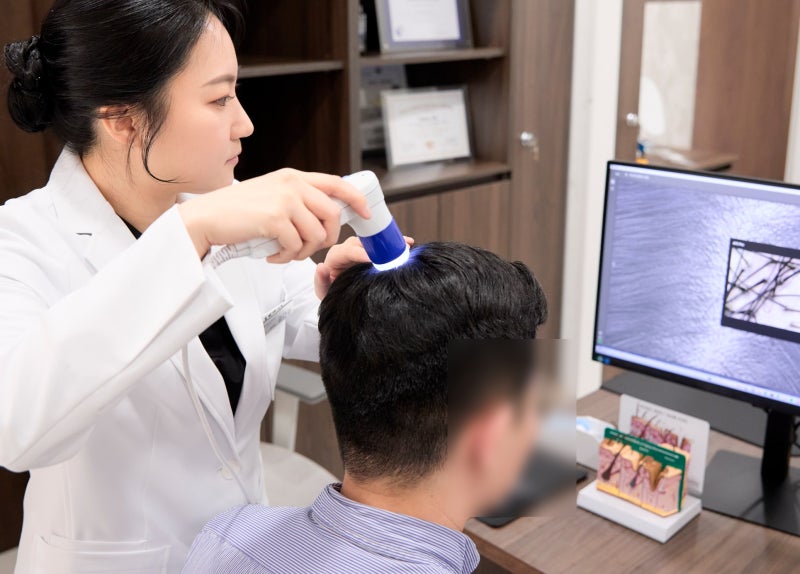
We examine the scalp and hair directly, using dermoscopy (magnified scalp examination) and blood tests as needed. When iron deficiency or thyroid disease is suspected, targeted laboratory tests are considered; however, not every individual requires identical testing.
Treatment strategies also vary according to the diagnosis. For male and female pattern hair loss, we discuss appropriate medical therapies. For telogen effluvium, we focus on identifying triggers and correcting nutritional imbalances. For alopecia areata or inflammatory conditions, specialized therapies are indicated.
Should I start by switching shampoos or taking supplements?
Using a scalp-appropriate cleanser and maintaining a well-balanced diet support general scalp hygiene. However, shampoo alone cannot cure progressive pattern hair loss, nor can general hair supplements resolve every type of hair loss.
Before taking supplements, it is essential to verify whether an actual nutritional deficiency exists. Rather than taking multiple supplements simultaneously out of anxiety, make sure your care regimen matches the root cause of your hair loss.
Consult a specialist if you notice persistent changes
If your daily shedding continues to increase, if noticeable thinning develops along your part or crown, or if your hair strands are gradually becoming finer, consider visiting a clinic for a professional evaluation. You do not need to wait until you hit a specific number of lost hairs or endure months of uncertainty.
If you are struggling with early signs of hair loss in Gangnam areas such as Seolleung, Yeoksam, or Daechi, bringing past photos, notes on recent changes, and your medication list will greatly assist the consultation.
At Cordia Clinic, we assess your scalp and hair health thoroughly to guide you toward customized treatments and care routines tailored to your specific condition.
〈Cordia Clinic Appointment Information〉
To provide thorough consultations and personalized care for every individual, Cordia Clinic operates strictly on a 100% reservation basis.
Please make an appointment before visiting so that you can receive care at your preferred time.
Feel free to inquire about medical consultations or documentation when booking or during your visit.
〈Clinic Hours〉
Monday · Tuesday · Thursday · Friday
11:00 AM – 8:00 PM
Lunch Break: 2:00 PM – 3:00 PM
Saturday
10:00 AM – 4:00 PM
Open continuously without a lunch break.
〈Location & Directions〉
6th Floor, KR Tower (Burger King Building), 429 Seolleung-ro, Gangnam-gu, Seoul, Cordia Clinic
Seolleung Station, Exit 3
〈Appointments & Inquiries〉
Phone: 02-568-8575
Feel free to reach out via KakaoTalk, Naver, or whichever channel is most convenient for you.
Frequently Asked Questions
Is losing more than 100 hairs a day always a sign of hair loss?
You cannot diagnose hair loss purely by the number of strands shed. While shedding 50 to 100 hairs daily is generally normal, the count can vary depending on brushing habits and shampoo frequency. Rather than the exact count, watch for whether your shedding has consistently increased compared to your baseline and whether overall volume is decreasing.
Why does heavy shedding occur after childbirth or dieting?
It is likely telogen effluvium triggered by childbirth, rapid weight reduction, high fevers, or severe physiological stress. Roughly 2 to 3 months after such a physical change, hair growth cycles shift prematurely into the resting phase, causing a temporary increase in diffuse shedding across the scalp.
Can anti-hair loss shampoo or supplements cure progressive hair loss?
Shampoos and supplements alone cannot cure progressive pattern hair loss. While proper cleansing and balanced nutrition support baseline scalp health, managing male or female pattern hair loss requires accurate medical diagnosis and targeted pharmaceutical therapies.
What tests are performed during an initial hair loss consultation?
Following a medical history interview to identify onset, medications, and family history, the scalp and hair are examined in detail with a high-magnification dermatoscope. Depending on clinical findings, blood tests may be ordered to rule out iron deficiency, thyroid dysfunction, or other systemic factors.
Should I see a doctor immediately if I develop circular bald spots or scalp pain?
Yes, you should visit a clinic promptly. Well-defined circular bald patches (alopecia areata) or symptoms like intense redness, localized pain, burning, and pus indicative of inflammatory diseases require early medical intervention to prevent permanent follicular damage.