2026-10-31
Can Tying Your Hair Too Tight Really Cause Hair Loss? Causes and Recovery of Traction Alopecia | Seolleung Station Hair Loss Clinic
Tying your hair too tightly can cause traction alopecia. This guide covers how it develops, early signs, whether hair can recover, and how to treat and prevent it.
Hello, I am Dajeong Kim, the chief physician at Cordia Clinic.
If you tie your hair up often, you have probably heard something like this at least once.
“I heard that tying your hair too tightly causes hair loss. Is that really true?”
Yes, repeatedly pulling your hair tightly and forcefully can actually cause hair loss.
Medically, this is called “traction alopecia.”
Fortunately, in the early stages, simply changing how you tie your hair may allow the hair to recover.
Today, we’ll look at how traction alopecia develops, its early symptoms, and how to treat and prevent it.
1. Why does traction alopecia occur?
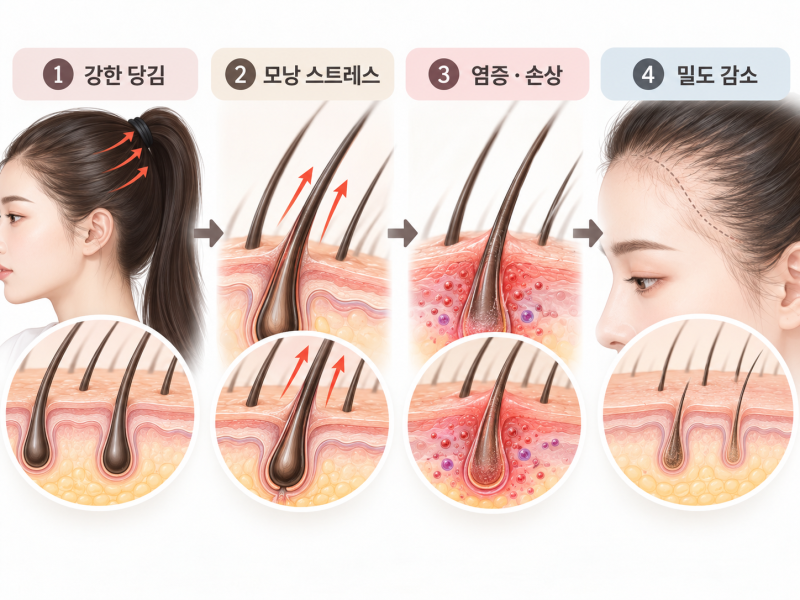
Traction alopecia is hair loss that occurs when hair is continuously pulled, putting mechanical stress on the hair follicles.
When hair is tied tightly, the pulling force is transmitted all the way down to the follicle.
When this stimulation repeats, inflammation can develop around the hair follicles or the hair can become damaged, and over time the thickness and density of the hair may decrease.
In particular, if strong tension is applied over a long period, fibrosis can form around the hair follicles, which may progress to permanent hair loss.
A 2023 paper published in JAMA Dermatology also explained that traction alopecia is initially non-scarring hair loss that can be reversed, but when it persists for a long time, it can progress to scarring alopecia.
2. Which hairstyles can cause hair loss?
With traction alopecia, the intensity and duration of the force applied to the hair matter more than the hairstyle itself.
Typically, the following cases call for caution.
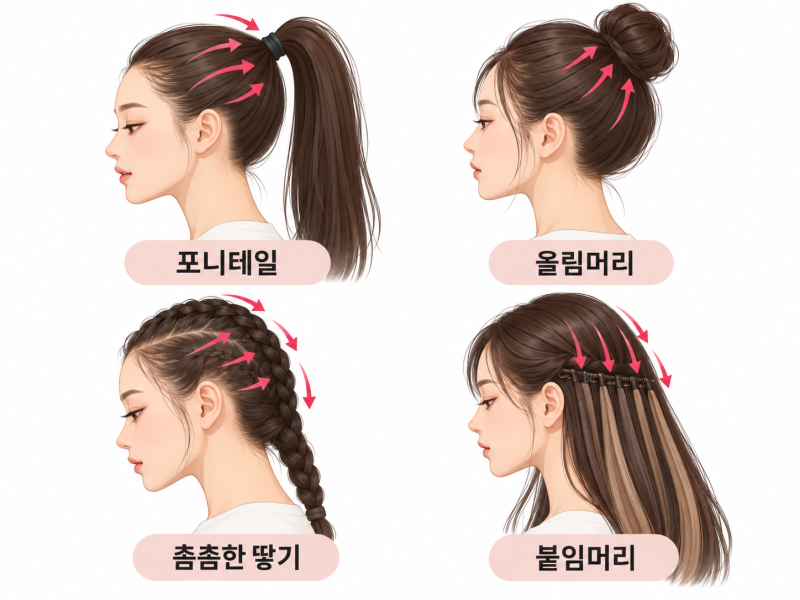
A ponytail pulled tightly back
An updo pinned tightly at the crown or the back of the head
Tight, firmly braided styles
Heavy hair extensions or hairpieces
In particular, tying your hair in the same spot every day can repeatedly stress the hair follicles in that area.
If your scalp feels tight or painful when you tie your hair, it may be a sign that excessive tension is being applied.
3. Where does traction alopecia start?
Traction alopecia mainly occurs in areas where the hair is being pulled.
Typically, hair becomes thinner or less dense along the hairline at the forehead, around the temples, and above the ears.
In the early stages, short broken hairs, redness of the scalp, or small inflammatory bumps may be observed.
A characteristic finding is the “fringe sign,” in which short hairs remain along the edge of the hairline.
However, widening of the hairline can also occur with other conditions, such as female pattern hair loss or frontal fibrosing alopecia, so accurate differential diagnosis is necessary.
4. Can traction alopecia be reversed?
This is the question many people are most curious about.
If the cause is removed early on, traction alopecia may allow the hair to grow back.
According to the British Association of Dermatologists (BAD), new hair growth may be observed about three months after the hair-pulling habit is stopped.
However, the speed and extent of recovery depend on the condition of the hair follicles.
Conversely, if traction has continued for a long time and the follicles have been destroyed and scarring has formed, natural hair regrowth may be difficult.
That’s why it is important to detect traction alopecia early and correct your everyday habits.
5. How is traction alopecia treated?
The most important treatment is to stop the habit of pulling your hair tightly.
Tie your hair loosely, change where you tie it, or wear it down whenever possible.
In addition, if the scalp is accompanied by inflammation, anti-inflammatory treatment may be considered at the discretion of your healthcare provider.
In early-stage traction alopecia, where the hair follicles are still intact, topical minoxidil is sometimes used as an adjunct to help hair regrowth.
However, if scarring changes have already occurred, it may be difficult to expect full recovery with medication alone.
6. Frequently Asked Questions
Q. Is it okay to tie my hair up every day?
Tying your hair up does not necessarily cause hair loss.
What matters is not pulling too tightly and making sure that force isn’t applied to the same area for long periods.
Q. If my scalp hurts after tying my hair, does that mean hair loss has started?
Pain alone cannot be used to diagnose traction alopecia.
However, recurring pain can signal that excessive tension is being placed on the hair follicles, so it’s a good idea to adjust your hairstyle.
7. Traction alopecia is preventable hair loss
Unlike genetic hair loss, traction alopecia is a condition that is strongly influenced by lifestyle habits.
Simply adjusting the habit of tying your hair tightly can reduce the risk of developing it.
In particular, if the hairline gradually widens or the hair around the temples becomes thinner, check whether it is simply caused by tying your hair or whether another type of hair loss may be involved.
The most important thing with traction alopecia is to correct the cause before permanent damage to the hair follicles occurs.
References
Larrondo J, McMichael AJ. (2023). Traction Alopecia. JAMA Dermatology.
British Association of Dermatologists. Traction Alopecia – Patient Information Leaflet.
American Academy of Dermatology. Hairstyles that pull can lead to hair loss.
Syed HA, Kaliyadan F. (2025). Traction Alopecia. StatPearls.
※ This article is intended to provide general medical information and does not replace individual diagnosis or treatment.
〈Cordia Clinic Appointment Information〉
Cordia Clinic operates on a 100% appointment-only basis to allow for thorough consultations and individualized care. Please book by phone, KakaoTalk, or Naver before your visit.
〈Appointments and Inquiries〉
Phone: 02-568-8575
Feel free to reach out via KakaoTalk, Naver booking, or any method that is convenient for you.
〈Office Hours〉
Mon, Tue, Thu, Fri: 11:00 AM – 8:00 PM
Lunch break: 2:00 PM – 3:00 PM
Saturday: 10:00 AM – 4:00 PM
We do not take a lunch break on Saturdays.
〈Directions〉
429 Seolleung-ro, Gangnam-gu, Seoul
6th Floor, KR Tower, Cordia Clinic
Seolleung Station Exit 3, the building with Burger King
#TractionAlopecia #TractionAlopeciaCauses #TractionAlopeciaTreatment #TractionAlopeciaRecovery #TractionAlopeciaSymptoms #HairTiedTooTight #HairTyingHabit #TightHairTying #PonytailHairLoss #UpdoHairLoss #HairExtensionHairLoss #HairlineLoss #WomensHairlineLoss #TempleHairLoss #BangsHairLoss #WomensHairLoss #WomensHairLossCauses #EarlyHairLossSymptoms #HairLossPrevention #HairLossLifestyleHabits #HairFollicleDamage #ScalpPain #ScalpCare #HairLossTreatment #HairLossCauses #GangnamHairLoss #SeolleungHairLoss #YeoksamHairLoss #DaechiHairLoss #CordiaClinic