2026-10-19
Female Pattern Hair Loss After Menopause: Why Does Hair Thin in Your 40s–60s? | Cordia Clinic, Seolleung Station
Explains why hair thins in women in their 40s–60s after menopause, including prevalence, estrogen's role, key symptoms, diagnosis, and treatment options for female pattern hair loss.
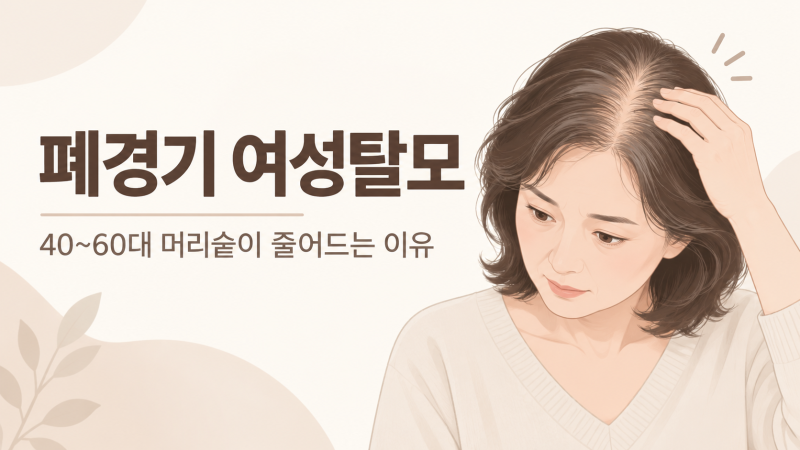
Hello. I am Dajeong Kim, Medical Director of Cordia Clinic.

“As I enter my 50s, my hair part seems to be getting wider.”
“My hair became thinner after menopause. Is it because my female hormones have decreased?”
“Is it a menopausal symptom that my hair volume has been decreasing since my 40s?”
These are questions that women in their 40s to 60s often ask when they are concerned about hair loss.
When they were younger, they had plenty of hair, but at some point the crown began to look sparse, or they noticed that their ponytail had become thinner.
These changes may not be explained simply by aging.
This is because around menopause, female hormone secretion changes, which can also affect the growth cycle and thickness of hair.
But there is an important fact to keep in mind.
Female hair loss during menopause is not caused by a decrease in estrogen alone. Several factors can act together, including genetic predisposition, changes in hair follicles, nutritional status, and thyroid disease.

1. How common is female hair loss after menopause?
A 2022 study published in Menopause recruited 200 postmenopausal women aged 50 to 65 and assessed their hair condition.
Among the 178 women whose evaluations were completed, the prevalence of female pattern hair loss (FPHL) was **52.2%**.

About 73% of the women with confirmed hair loss were at the relatively early Ludwig Stage 1.
The study identified age, years since menopause, and body mass index (BMI) as factors associated with female pattern hair loss.
However, this study was a cross-sectional study of postmenopausal women in a specific region, so it does not mean that the hair loss rate is 52.2% for all women.
In addition, it is not a study that proved a causal relationship in which menopause directly induces hair loss.
Even so, it shows the need to carefully monitor hair changes in women around menopause.
2. Why does hair become thinner when estrogen decreases?
Estrogen is a hormone that affects not only female reproductive function but also the skin and hair follicles.

Hair follicles are tissues that can be influenced by estrogen, and the hair growth cycle may change with hormonal shifts.
Around menopause, estrogen secretion from the ovaries decreases.
During this process, changes can occur in the growth (anagen) and resting (telogen) phases of hair, as well as in hair thickness.
In addition, as female hormones decline, the relative influence of androgens may change.
However, this does not mean that male hormones necessarily increase after menopause.
Female pattern hair loss can also occur in women whose blood androgen levels are normal, and genetic sensitivity of the hair follicles and various regulatory mechanisms are involved.
Therefore, a decline in estrogen may contribute to hair changes during menopause, but female pattern hair loss cannot be explained by a lack of female hormones alone.
3. Typical symptoms of female pattern hair loss during menopause
In female pattern hair loss, follicular miniaturization (hair follicle miniaturization) is an important feature.
Follicular miniaturization refers to the phenomenon in which hair follicles that once produced thick hair gradually produce thinner, shorter hairs.
The typical changes are as follows.
The part gradually widens
The scalp at the crown becomes more visible than before
The ponytail becomes thinner when the hair is tied up
Overall hair volume decreases
Thick and thin hairs appear mixed together
In particular, female pattern hair loss often involves decreased density at the crown and part, rather than significant recession of the hairline as seen in male pattern hair loss.
The American Academy of Dermatology (AAD) also describes widening of the part and decreased thickness of the ponytail as major changes in female pattern hair loss.
4. If hair falls out after menopause, is it always female pattern hair loss?
No, it is not.
Several types of hair loss can occur at the same time in women in their 40s to 60s.
Hair loss type | Key features |
Female pattern hair loss | Widening part, gradual miniaturization of crown hair |
Telogen effluvium | Increased overall hair shedding over a short period |
Hair loss related to iron deficiency or thyroid disease | Hair loss that may accompany nutritional or endocrine abnormalities |
Frontal fibrosing alopecia | Frontal hairline recession, eyebrow loss, and possible inflammation and scarring |
Frontal Fibrosing Alopecia, in particular, is a scarring hair loss condition that is observed relatively often in postmenopausal women.
It presents as a band-like recession of the frontal hairline and thinning eyebrows, and it may be accompanied by itching or redness of the scalp.
Because this condition can permanently damage hair follicles, early diagnosis is important.
Therefore, it is not appropriate to assume that all hair loss is due to menopausal changes and delay treatment.
5. How is female hair loss during menopause diagnosed?
If female pattern hair loss is suspected, trichoscopy (scalp magnification) can be used to check differences in hair density and thickness.
In particular, it is important to check whether the difference in diameter between thick and thin hairs in the crown has increased.
We also review recent weight changes, eating habits, current medications, family history, and the timing of menopause.
If necessary, blood tests may be considered, including tests for anemia and iron stores, as well as thyroid function.
If sudden hair loss is accompanied by symptoms suggesting androgen excess, such as excessive hair growth or acne, additional hormonal evaluation may be needed.
However, not every woman going through menopause needs the same blood tests.
6. How is female hair loss during menopause treated?
Topical minoxidil

This is one of the treatments with well-established clinical evidence for female pattern hair loss.
Minoxidil can help promote hair growth and slow the progression of hair loss.
However, evaluating its effect generally requires continuous use for about 6 to 12 months.
Scalp irritation or unwanted hair growth in other areas may occur, and if use is stopped, the maintained effect may decline.
Oral medication
In some patients, drug therapies such as low-dose oral minoxidil, spironolactone, or finasteride may be considered.
However, these drugs differ in their approved indications and level of evidence for female pattern hair loss, and some are off-label uses.
In particular, oral minoxidil requires attention to edema, rapid heart rate, and changes in blood pressure, while spironolactone requires consideration of hyperkalemia and kidney function-related issues.
Around menopause, it is also important to check the possibility of pregnancy, any underlying conditions, and the medications being taken.
Scalp injections and adjunct treatments
PRP, microneedling, and low-level laser therapy (LLLT) are also being studied for female pattern hair loss.

Some studies have reported positive results, but the level of evidence and consistency of effects differ for each treatment.
Therefore, it is difficult to generalize that these treatments are superior to existing drug therapies.
7. Can replacing female hormones restore hair volume?
This is a question that many people ask about hair loss during menopause.
Since estrogen may affect hair follicles, one might think that replenishing female hormones could also restore hair volume.
However, based on current research alone, it cannot be concluded that menopausal hormone therapy reliably improves female pattern hair loss.
A 2026 review on menopausal hormone therapy and hair also explains that starting hormone replacement therapy solely to treat hair loss is not recommended.
Hormone therapy should be decided by considering menopausal symptoms, the individual's health status, and the benefits and risks of treatment.
It is not appropriate to take female hormone medications arbitrarily simply because hair loss is present.
Frequently Asked Questions
Q. Does hair loss during menopause recover on its own?
If it is temporary telogen effluvium, hair may recover once the underlying cause is resolved. On the other hand, female pattern hair loss is often progressive, so treatment may be needed depending on the condition.
Q. If my part widens in my 50s, is it female pattern hair loss?
It is possible, but it cannot be diagnosed from changes in the part alone. Hair thickness, density, and scalp condition need to be checked.
Q. Can biotin or collagen supplements help with hair loss during menopause?
If there is a deficiency of a specific nutrient, replenishing it may be important. However, there is not sufficient evidence that taking supplements in people without a deficiency improves female pattern hair loss.
Closing Thoughts
Female hair loss after menopause is difficult to regard as a natural change that comes with aging alone.
Changes in female hormones, the genetic characteristics of hair follicles, the hair growth cycle, and nutritional status can all be involved in complex ways.
In particular, if the part widens and hair gradually thins in your 40s to 60s, it is worth considering female pattern hair loss.
However, if hair suddenly sheds heavily, or the hairline recedes and the eyebrows also become thinner, other hair loss conditions should be ruled out.
The key to hair loss during menopause is not to replace female hormones indiscriminately, but to determine which type of hair loss is actually progressing.
Accurately distinguishing the cause can help you choose appropriate treatment and reduce unnecessary procedures.
References and Medical Evidence
Chaikittisilpa S, et al. Prevalence of female pattern hair loss in postmenopausal women: a cross-sectional study. Menopause. 2022;29(4):415–420.
Menopause and hair loss in women: Exploring the hormonal transition. Maturitas. 2025;198:108378.
Female-pattern hair loss: therapeutic update. Anais Brasileiros de Dermatologia. 2023;98(4):506–519.
Farkas E, et al. Untangling estrogen therapy for menopausal hair loss: A systematic review. Journal of the American Academy of Dermatology. 2026;95(3):756–758.
American Academy of Dermatology Association. Thinning hair and hair loss: Could it be female pattern hair loss?
DermNet. Frontal fibrosing alopecia.
※ This article provides general medical information on the causes and treatment of female hair loss during menopause. The prevalence and treatment outcomes presented in studies do not apply identically to all patients. Actual treatment should be decided by considering the type of hair loss, underlying conditions, and the approved indications of medications.
〈Cordia Clinic Appointment Information〉
Cordia Clinic operates by appointment only (100%) to allow for sufficient consultation and individualized care. Please make an appointment by phone, KakaoTalk, or Naver before your visit.
〈Appointments and Inquiries〉
Phone: 02-568-8575
Please contact us through whichever method is most convenient for you, such as KakaoTalk or Naver booking.
〈Office Hours〉
Mon, Tue, Thu, Fri: 11:00 AM – 8:00 PM
Lunch break: 2:00 PM – 3:00 PM
Saturday: 10:00 AM – 4:00 PM
We see patients on Saturdays without a lunch break.
〈Directions〉
429 Seolleung-ro, Gangnam-gu, Seoul
Cordia Clinic, 6th Floor, KR Tower
Exit 3 of Seolleung Station, the building with the Burger King