2026-10-30
Hair Loss Self-Check near Seolleung Station: What Stage Is Your Hair Loss At Now?
A guide to self-checking hair loss stages with the Hamilton-Norwood, Ludwig, and BASP classification charts, plus mirror checks and when to see a clinic.
Hello, I am Dajeong Kim, the chief physician at Cordia Clinic.
Classification charts can help you gauge where your hair loss started and how far it has progressed, but they are for reference only.
An accurate stage and treatment plan must be confirmed through an in-person examination.
It is widely reported that the earlier the stage, the more likely hair can be preserved with non-surgical treatment, so it is best to check early.
Below, we go through the classification charts for men, women, and both sexes in turn and outline what to check in the mirror.

This is the lobby of Cordia Clinic. The image was provided by the clinic.
Why and by whom were hair loss stages classified?
Hair loss classification systems were created so that doctors and patients can discuss the degree of progression using the same criteria and decide on a treatment direction.
Because the phrase "a lot of hair loss" means something different to each person, a common visual standard was needed.
The oldest system was proposed by Hamilton in 1951. In 1975, Norwood refined it, and it became the "Hamilton-Norwood scale," the most widely used scale for male pattern hair loss today.
It is also often called the "Hamilton-Norwood classification" or the "Norwood classification."
Men and women lose hair in different areas, so there are separate classification charts for each.

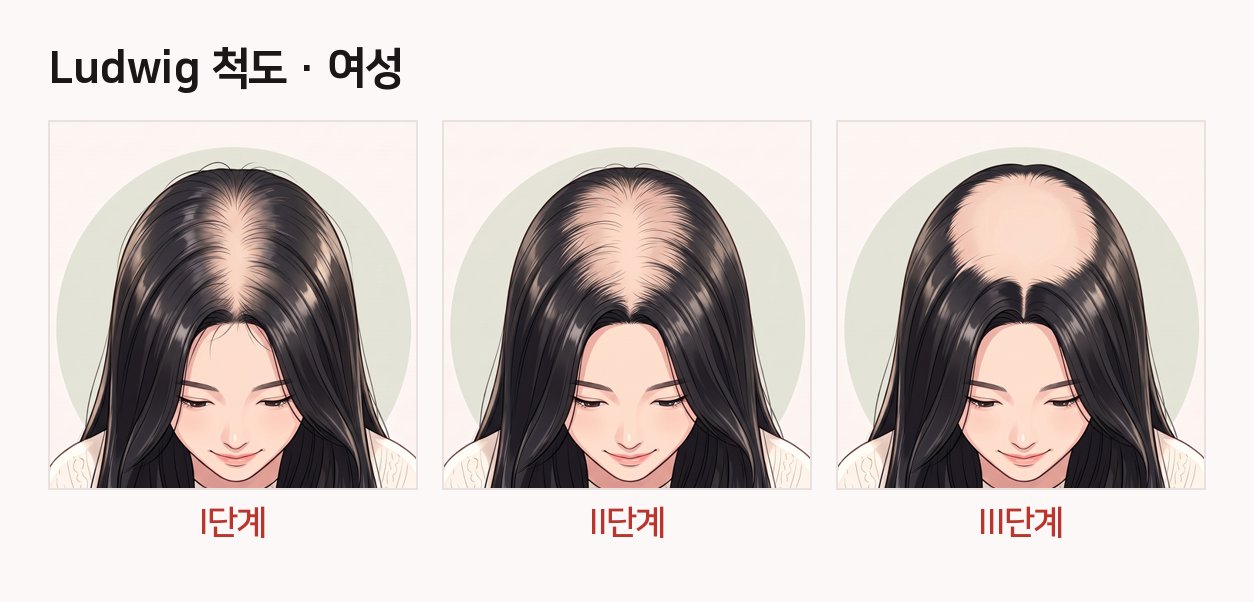
Below, we look at these three areas, one for each classification chart. The image is AI-generated and does not depict a real patient.
What areas are used to classify male pattern hair loss?
The Hamilton-Norwood scale divides male pattern hair loss into stages, from the non-balding stages (I–III) to advanced hair loss (IV–VII). It classifies patterns in which hairline recession and crown hair loss progress either separately or at the same time.
The hairline here is the one most people mean when they say "hairline." The crown is the back of the top of the head, around the cowlick.
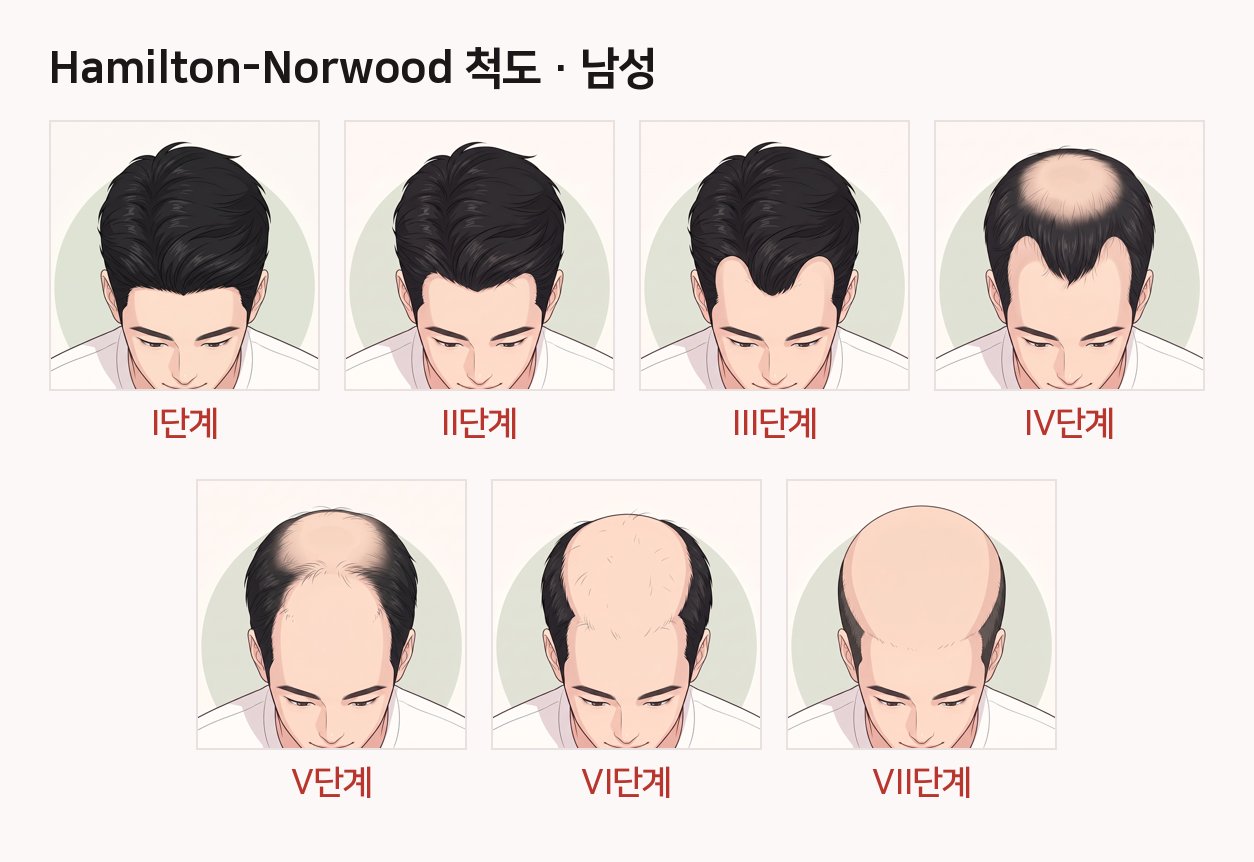
Stage I: The hairline has barely receded.
Stage II: The hairline recedes into a triangular shape at both temples.
Stage III: The temples recede more deeply, so the scalp shows through or the hair is very sparse.
Stage IV: The hairline recedes further, and hair at the crown thins out. A band of hair remains between the two areas.
Stage V: Both areas grow larger, and the band of hair between them becomes narrower and thinner.
Stage VI: The band between them disappears, and the frontal and crown areas merge into one.
Stage VII: Hair remains only on the sides and back of the head, in a horseshoe shape.
This is an AI-generated illustration for reference only and does not depict a real patient.
Check in the mirror □ Has the hairline above both temples receded inward in an M-shape? □ Does more of your scalp show through at the crown than before?
Why is female hair loss assessed separately?
Female pattern hair loss follows a different pattern from male, so it required its own classification system. The best-known example is the three-stage scale proposed by Ludwig in 1977.
This scale is based on a pattern in which the frontal hairline remains relatively intact while the crown gradually thins and diffuses. It is also commonly called the "Ludwig classification."
Stage I: Thinning begins to show at the crown, starting 1–3 cm behind the frontal hairline.
Stage II: The same area becomes more noticeably sparse.
Stage III: Hardly any hair remains in that area.
This is an AI-generated illustration for reference only and does not depict a real patient.
Check in the mirror □ When you part your hair down the middle, does the part look wider than before? □ Does your frontal hairline look unchanged while only the crown looks thinner?
How do you read the BASP classification, which applies to both men and women?
In 2007, the BASP classification was published as a unified system that can be applied to both men and women.
It evaluates both the shape of the frontal hairline (basic type: L, M, C, U) and the degree of density loss in the crown and frontal areas (specific type: F, V). This allows hair loss patterns to be recorded more precisely, regardless of sex.
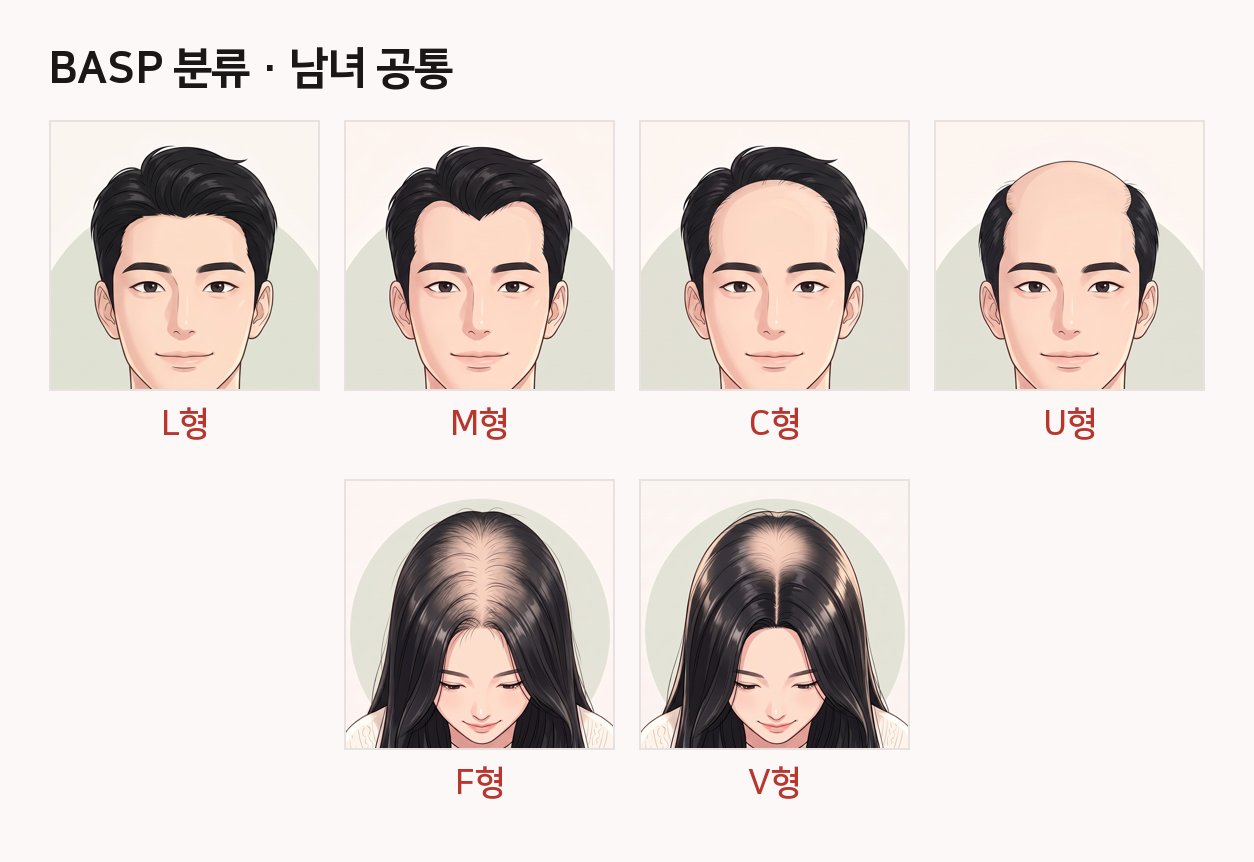
Basic type: Frontal hairline shape
L type: A straight hairline that has not receded.
M type: An M-shaped hairline, with both sides receding more than the center.
C type: The center recedes further, so the entire hairline curves inward like a semicircle.
U type: A horseshoe shape in which the hairline has receded all the way back to the crown.
Specific type: Hair density
F type: Hair density decreases across the top of the head, and the front is more pronounced.
V type: Hair density around the crown decreases more noticeably.
This is an AI-generated illustration for reference only and does not depict a real patient. This classification is used for both men and women.
The final notation combines the basic and specific types, written like C1V1. The number after each letter indicates the degree of progression.
Check in the mirror □ Has the hairline receded more at the sides, or more in the center? □ Does your hair look thinner at the front or toward the crown?
Chart | Published | Target | Main area assessed | Stage notation |
Hamilton-Norwood scale | Proposed 1951, refined 1975 | Men | Hairline recession, crown | I–VII |
Ludwig scale | 1977 | Women | Crown (frontal hairline relatively preserved) | 3 stages |
BASP classification | 2007 | Men and women | Frontal hairline shape + crown/frontal density | Basic L·M·C·U + specific F·V |
Overview of the three hair loss classification charts
When is the best time to see a clinic for hair loss?
It is important to visit a clinic while hair loss is still at an early stage (for example, Hamilton I–II, Ludwig I, or a stage with minimal density loss on the BASP scale).
This is when the hairline has just started to recede into an M-shape, or when the hair at the crown begins to look slightly thinner when you part your hair.
At this stage, non-surgical treatments such as PRP, PDRN, minoxidil, and scalp injection therapy are reported to have a higher likelihood of preserving hair.
Non-surgical treatments refer to therapies that use medication or injections without surgery.
Can you judge from the classification charts alone?
However, these charts are only reference self-assessment tools. Studies have also found that even when the same classification is used, medical professionals do not fully agree on their ratings.
When dermatologists and physicians in training rated the same male scalp photos using the Hamilton-Norwood scale, their ratings did not agree sufficiently with one another.
When the same person reviewed the same photos a few months later, the results did not match their original ratings well.
Therefore, rather than judging on your own from photos or illustrations, it is important to confirm your exact stage and treatment plan through an in-person examination by a specialist.
If you are worried, what should you do now?
· Check three areas in the mirror — Look at your hairline, crown, and part using the questions in the boxes above.
· Don't put it off — The time to see a clinic is when changes have just started to appear.
· Get it checked in person — Don't determine your stage from photos or illustrations alone.
Classification charts are only a starting point. It is important to confirm your exact stage and treatment plan through a direct examination by your medical team.
Frequently Asked Questions
Q. Can women's hairlines also recede into an M-shape?
In rare cases, some women experience hairline recession similar to men's. In these cases, they are recorded using the Hamilton method or the BASP classification, which applies to both sexes, rather than the Ludwig scale.
Q. Does it count as a hair loss stage if only the crown looks thin while the frontal hairline stays the same?
Yes. The BASP classification, which applies to both sexes, records the degree of thinning around the crown as the V type, separately from the hairline shape. The Hamilton-Norwood scale also has a separate crown-dominant pattern, in which hair loss starts at the crown and the hairline recedes only slightly.
Q. Should people in their 20s and 30s also check their hair loss stage early?
Even in your 20s or 30s, it is worth checking if your hairline, crown, or part looks different from before. In a Korean study that introduced the BASP classification, 65.1% of men and 56.68% of women who visited a clinic for hair loss were in their 20s or 30s.

This image was provided by the clinic and is not a before-and-after photo of a treatment.
Consultation and Booking Information
Phone consultation / Booking | 02-568-8575If your hairline, crown, or part looks different from before, come in for a consultation to find out what stage you are at. Costs will be explained during your consultation. |
Clinic hours | Mon, Tue, Thu, Fri 11:00 – 20:00 (lunch break 14:00 – 15:00) Saturday 10:00 – 16:00 Last registration: weekdays 19:00 · Saturday 15:00 Closed — Wednesday · Sunday · Public holidays |
Location | 6th Floor, KR Tower, 429 Seolleung-ro, Gangnam-gu, SeoulAbout a 1-minute walk from Exit 3 of Seolleung Station |
References
· Norwood OT. Male pattern baldness: classification and incidence. South Med J. 1975;68(11):1359-65. — Abstract (PMID 1188424) https://pubmed.ncbi.nlm.nih.gov/1188424/
· Ludwig E. Classification of the types of androgenetic alopecia (common baldness) occurring in the female sex. Br J Dermatol. 1977;97(3):247-54. — Abstract (PMID 921894) https://pubmed.ncbi.nlm.nih.gov/921894/
· Lee WS, Ro BI, Hong SP, et al. A new classification of pattern hair loss that is universal for men and women: basic and specific (BASP) classification. J Am Acad Dermatol. 2007;57(1):37-46. — Abstract (PMID 17467851) https://pubmed.ncbi.nlm.nih.gov/17467851/
· Gupta M, Mysore V. Classifications of Patterned Hair Loss: A Review. J Cutan Aesthet Surg. 2016;9(1):3-12. — Full text (PMC4812885) https://pmc.ncbi.nlm.nih.gov/articles/PMC4812885/
· Guarrera M, Cardo P, Arrigo P, Rebora A. Reliability of Hamilton-Norwood classification. Int J Trichol. 2009;1(2):120-2. — Full text (PMC2938573) https://pmc.ncbi.nlm.nih.gov/articles/PMC2938573/
This article is intended to provide general health information and does not replace individual diagnosis or treatment. The progression of hair loss and response to treatment vary from person to person. Non-surgical treatments mentioned in this article may also cause side effects and may not be suitable for everyone, so they should be discussed during a consultation.
#HairLossSelfCheck #HairLossStage #HairLossProgression #NorwoodClassification #HamiltonNorwood #LudwigClassification #BASPClassification #MShapedHairLoss #CrownHairLoss #FemaleHairLoss #PartingHairLoss #MalePatternHairLoss #EarlyHairLossSigns #SeolleungStationHairLoss #YeoksamDongHairLoss #CordiaClinic