2026-10-28
Will Eating Less Protein Make Your Hair Fall Out? Protein Deficiency and Hair Loss | Seolleung Station Hair Loss Clinic
Explains how severe protein shortage or rapid weight loss can trigger telogen effluvium, when shedding typically appears, daily protein guidelines, and when to get a blood test.
Hello. I am Dr. Dajeong Kim, Director of Cordia Clinic.
Some people notice their hair shedding more after starting a diet or after eating less.
In particular, after losing weight quickly, they may become worried when they see more hair than usual coming out while washing or combing their hair.
But will eating too little protein really cause hair loss?
To answer up front, hair loss can occur if protein intake is severely insufficient or nutritional deficiency persists.
Today, we will look at why protein is necessary for hair growth and the characteristics of hair loss caused by nutritional deficiency.
1. Hair is made of protein
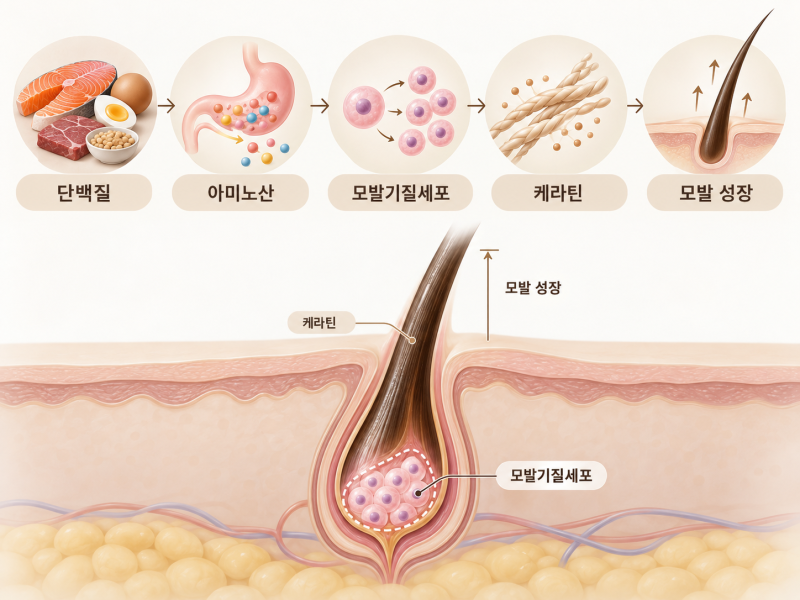
The main component of hair is a protein called keratin.
Our bodies break down protein from food into amino acids and use them to synthesize new proteins.
The matrix cells in hair follicles actively multiply to produce new hair.
This process requires a sufficient supply of amino acids and energy.
Therefore, if protein supply is lacking over a long period, it can affect normal hair growth.
2. Protein deficiency can trigger telogen effluvium
Hair goes through repeated cycles of growth (anagen), regression (catagen), and resting (telogen).
When protein and calorie intake are severely insufficient, some hair follicles may end their growth phase early and switch to the resting phase.
Hair loss that occurs this way is called "telogen effluvium."
A key feature of telogen effluvium is that heavy shedding may not start right after the nutritional deficiency begins, but about 2 to 3 months later.
Also, rather than hair falling out only in specific areas, shedding tends to occur fairly evenly across the whole scalp.
A 2017 review published in Dermatology Practical & Conceptual also explained that reduced protein intake and rapid weight loss can cause telogen effluvium.
3. How much protein should you eat per day?
The Korea Disease Control and Prevention Agency's National Health Information Portal (2026) recommends a protein intake of about 0.8 to 1.2 g per kg of body weight per day for healthy adults.
For example, a person weighing 60 kg would consume roughly 48 to 72 g of protein per day.
Representative foods that provide protein include the following.
Eggs and dairy products
Fish and meat
Tofu and legumes
Nuts
Rather than eating only certain foods repeatedly, it is best to consume a variety of foods in a balanced way.
Also, if you have a condition such as kidney disease, your protein intake should be adjusted individually.
4. Will eating more protein make your hair thicker again?
If hair growth was hindered by protein shortage, improving your nutritional status may allow normal hair growth to recover.
A review published in the Cleveland Clinic Journal of Medicine in 2026 also explained that telogen effluvium caused by nutritional deficiency or other factors can gradually recover once the underlying cause is corrected.
However, because of the hair growth cycle, recovery may take several months.
In contrast, in male-pattern and female-pattern hair loss, hair follicles gradually shrink due to genetic factors and the influence of hormones.
In these cases, hair loss is not resolved simply by eating more protein.
In other words, correcting a protein shortfall and eating more protein when your nutritional status is already adequate are different things.
5. What if your hair loss got worse after dieting?
If hair loss occurs after rapid weight loss, it is worth checking not only protein intake but also overall calorie intake and nutrients such as iron.
In particular, if you have significantly reduced your meals or lost weight quickly, telogen effluvium caused by nutritional deficiency may be a possibility.
However, not all hair loss is caused by nutritional deficiency.
When necessary, a blood test can check for anemia, iron deficiency, and thyroid dysfunction, and a scalp magnification exam can assess whether pattern hair loss is also present.
6. A balanced diet is key to healthy hair
Protein is an essential nutrient for normal hair growth.
However, eating large amounts does not automatically make your hair thicker.
What matters most is consistently eating an amount suited to your health status and activity level.
If you are concerned about hair loss, it is better to first identify the cause rather than taking large amounts of specific nutrients.
References
Guo EL, Katta R. (2017). Diet and hair loss: effects of nutrient deficiency and supplement use. Dermatology Practical & Conceptual.
Bergfeld WF, Mendez D. (2026). Shedding: An updated guide to a common cause of hair loss. Cleveland Clinic Journal of Medicine.
Harvard Health Publishing. (2026). Can insufficient protein intake cause hair loss?
Korea Disease Control and Prevention Agency National Health Information Portal. (2026). Protein: Take It in the Amount That Suits Your Body.
※ This article is intended to provide general medical information and does not replace diagnosis or treatment based on an individual's condition.
〈Cordia Clinic Appointment Information〉
Cordia Clinic operates on a 100% appointment basis to allow for sufficient consultation and individualized care. Please book by phone, KakaoTalk, or Naver before your visit.
〈Booking and Inquiries〉
Phone: 02-568-8575
Please contact us through whichever method is most convenient for you, such as KakaoTalk or Naver booking.
〈Office Hours〉
Mon · Tue · Thu · Fri: 11:00 AM – 8:00 PM
Lunch break: 2:00 PM – 3:00 PM
Saturday: 10:00 AM – 4:00 PM
We see patients on Saturdays without a lunch break.
〈Directions〉
429 Seolleung-ro, Gangnam-gu, Seoul
6th Floor, KR Tower, Cordia Clinic
Exit 3 of Seolleung Station, the building with the Burger King
#ProteinDeficiencyHairLoss #ProteinHairLoss #ProteinIntake #ProteinDeficiencySymptoms #HairLossCauses #HairLossFoods #HairLossPreventionFoods #DietHairLoss #WeightLossHairLoss #RapidWeightLoss #TelogenEffluvium #NutritionalDeficiencyHairLoss #NutrientDeficiencyHairLoss #WhyHairFallsOut #HowToThickenHair #HairHealth #HairGrowth #HairNutrition #Keratin #IronDeficiencyHairLoss #WomensHairLoss #MensHairLoss #CrownHairLoss #HairLossTreatment #GangnamHairLoss #SeolleungHairLoss #YeoksamHairLoss #DaechiHairLoss #SeolleungStationHairLoss #CordiaClinic
Frequently Asked Questions
Will you really lose hair if you eat too little protein?
Hair loss can occur if protein intake is severely insufficient or nutritional deficiency persists. Because hair's main component, keratin, is made of protein, a long-term lack of protein supply can affect normal hair growth.
When does hair loss caused by protein deficiency appear?
Heavy shedding may begin about 2 to 3 months after the nutritional deficiency, rather than right away. Hair may fall out fairly evenly across the whole head instead of only in specific areas.
How much protein should I eat per day?
The Korea Disease Control and Prevention Agency's National Health Information Portal recommends about 0.8 to 1.2 g of protein per kg of body weight per day for healthy adults. For example, a person weighing 60 kg would need roughly 48 to 72 g per day.
What are representative foods that provide protein?
Eggs and dairy products, fish and meat, tofu and legumes, and nuts are commonly cited as representative protein sources. However, it is best to eat a variety of foods in a balanced way rather than repeatedly eating only certain items.
Will my hair get thicker again if I eat more protein?
If hair growth was hindered by protein shortage, normal hair growth may recover once nutritional status improves. However, because of the hair growth cycle, recovery may take several months, and eating more does not automatically make hair thicker.
If my hair loss got worse after dieting, what should I check?
It is worth checking not only protein but also overall calorie intake and nutrients such as iron. When needed, a blood test can check for anemia, iron deficiency, and thyroid dysfunction, and a scalp magnification exam can assess whether pattern hair loss is also present. Not all hair loss is caused by nutritional deficiency.