2026-11-14
How Is Multiple Alopecia Areata Treated? Causes and Treatment Options
Multiple alopecia areata is an autoimmune condition that causes hair loss. This guide covers its types, causes, diagnosis, and treatments, from steroid injections to JAK inhibitors.
Hello.
I am Dr. Dajeong Kim, Chief Director of Cordia Clinic.
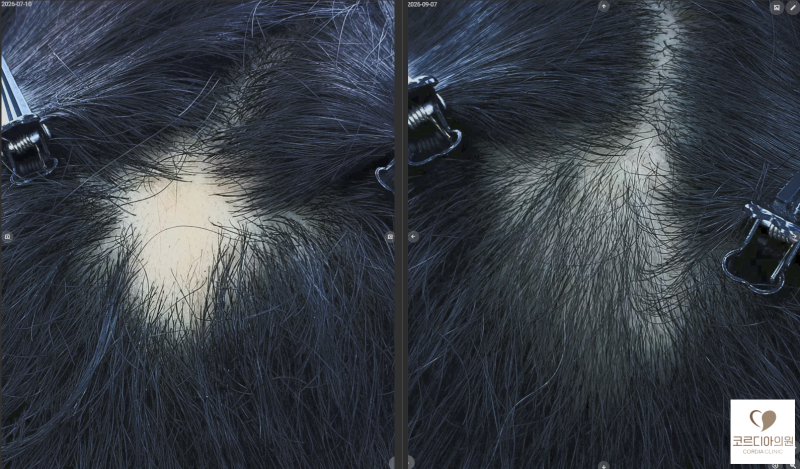
Multiple alopecia areata is an autoimmune disease in which the immune system attacks the hair follicles that produce hair, and treatment for alopecia areata depends on the extent of hair loss.

Image provided by the clinic.
What Is Multiple Alopecia Areata?
Alopecia areata is an autoimmune skin disease in which the immune system mistakenly identifies healthy hair follicles as a threat and attacks them, causing hair loss. The most common form is round, coin-sized bald patches on the scalp. When there is only one patch, it is called single alopecia areata; when there are several, it is called multiple alopecia areata.
About 2% of people worldwide experience alopecia areata at least once in their lifetime, and more than 80% of patients develop symptoms before the age of 40.

The illustration above explains how alopecia areata develops and the difference between single and multiple forms.
Types of Alopecia Areata, from Single Patches to Universal Hair Loss
· Single and multiple patches — the most common type. Most cases stay this way, but they can also spread.
· Alopecia totalis — the entire scalp loses its hair.
· Alopecia universalis — hair is lost across the whole body, including eyebrows and eyelashes.
· Diffuse — hair thins suddenly across the entire scalp, making it hard to distinguish from other types of hair loss.
· Ophiasis — hair falls out in a band along the sides and back of the head.
Regardless of the type, the course is hard to predict, and hair can fall out and regrow repeatedly. However, the hair follicles remain alive.
What Causes Alopecia Areata?
The reason the immune system attacks hair follicles and what triggers it are still unknown.
Several genetic factors are involved, but even among identical twins, who share the same genes, if one twin has alopecia areata, the other has a 55% chance of developing it.
It often occurs alongside other immune or allergic conditions, such as thyroid disease and atopic dermatitis.
How Is Alopecia Areata Diagnosed?
Alopecia areata is usually diagnosed by examining the bald patches and nails, along with taking a medical and family history.
In some cases, a skin biopsy or blood tests (thyroid, iron, and vitamins) may be needed.
At Cordia Clinic, we examine the scalp using a scalp magnifier and AFS 3D and AI analysis. If blood tests or a biopsy are deemed necessary, we refer patients to medical institutions that can perform those tests.


Alopecia Areata Treatment Depends on the Extent of Hair Loss
Treatment for alopecia areata is determined by the amount and duration of hair loss, the affected area, and the patient's age.
There is no single treatment that works for everyone, and treatment is not always recommended.

Here is a summary of guidance from the American Academy of Dermatology.
If there are one or two bald patches and the condition has lasted less than a year,
you can start with a wait-and-see approach. Many cases regrow without treatment, but if regrowth falls short of expectations, topical steroids are commonly applied, and minoxidil is often used to maintain the regrown hair.
Localized steroid injections can also be used.

If there are multiple bald patches,
adults may receive steroid injections, commonly called alopecia areata shots, into the patches every four to six weeks. In a study of 127 patients with bald patches, more than 80% of those who received injections regrew more than half of their lost hair within 12 weeks.
Injections can be painful and do not prevent new hair loss. Repeated steroid injections can cause side effects such as skin atrophy, so it is important to follow the appropriate concentration and injection interval.
If hair loss is extensive, such as alopecia totalis or universalis,
extensive hair loss rarely regrows without treatment.
Topical immunotherapy involves applying a substance to the skin at the clinic once a week to intentionally cause a rash. The regrowth rate ranges from 17% to 75%. Maintaining results usually requires continued treatment.
Oral steroids cannot be used long term due to side effects such as weight gain, osteoporosis, and elevated blood sugar and blood pressure.
New Treatment Trends: JAK Inhibitors and International Guidelines
JAK inhibitors are oral medications that block immune signals. The U.S. National Alopecia Areata Foundation considers them a first-line treatment for severe alopecia areata. Severe typically means more than half of the scalp has lost hair.
Agency | Drug | Decision |
U.S. FDA | Baricitinib | Approved for severe cases in people aged 12 and older |
U.S. FDA | Ritlecitinib | Approved for people aged 12 and older with extensive hair loss |
U.S. FDA | Deuruxolitinib | Approved for severe cases in adults |
NICE (2024) | Ritlecitinib | Recommended for severe cases in people aged 12 and older (when the manufacturer meets pricing conditions) |
NICE (2023) | Baricitinib | Not recommended for severe cases in adults (requires continuous use, and the cost was judged high relative to the benefit) |
JAK inhibitors: overseas agency decisions (The UK's NICE determines whether a drug is used in public healthcare, and its criteria differ from Korea's national health insurance standards)
In clinical trials, among people taking ritlecitinib, the proportion whose scalp hair loss area decreased to 20% or less was 23.0% at 24 weeks (21.4 percentage points higher than placebo) and 43.2% at 48 weeks.
However, the NICE assessment (2024) did not include results beyond two years or data after treatment was stopped, and the drug was less effective for alopecia totalis and universalis.
In Korea, starting July 1, 2026, national health insurance coverage has also been expanded to include baricitinib for severe alopecia areata; however, specific criteria must be met.
Before taking a JAK inhibitor, keep these points in mind · The approved labeling includes warnings about serious infections, including tuberculosis, blood clots, cardiovascular events such as heart attack and stroke, cancer, and risk of death. · Tuberculosis testing should be done before and during treatment, and the drug should not be used if you have active tuberculosis. · Headache and acne are common, and infections such as shingles can also occur. This medication does not work for everyone, so weigh the risks and benefits with your healthcare provider.
What Should You Do Now If You Have Multiple Alopecia Areata?
If the bald area is spreading quickly or new patches appear in multiple areas, don't delay seeing a doctor.
· Keep a record of your patches — note the number and size of patches, when they appeared, and whether anyone in your family has alopecia areata, and share this at your appointment.
· Check the extent of hair loss — at Cordia Clinic's hair loss diagnosis, we evaluate patch size and number, the speed of progression, and scalp condition.
· Discuss treatment options — we also consult on hair loss medications, such as minoxidil, which is used to maintain regrown hair.
Frequently Asked Questions
Q. Can multiple alopecia areata be cured?
There is no cure yet. However, hair can still regrow even after extensive loss over a long period.
Q. Is alopecia areata passed on to children?
Even if a parent has alopecia areata, the likelihood of it developing in a child is low.
Q. Can the nails also change?
Changes such as small pits or nails that break easily can also occur.

Image provided by the clinic.
Consultation and Booking Information
Phone Consultation / Booking | 02-568-8575 If you have developed multiple patches or your hair loss is spreading quickly, please have your scalp checked at a consultation now. Costs are covered under health screening, and details will be provided during your consultation. |
Office Hours | Mon, Tue, Thu, Fri 11:00–20:00 (lunch break 14:00–15:00) Saturday 10:00–16:00 Registration closes: weekdays 19:00 · Saturday 15:00 Closed — Wednesdays · Sundays · Public holidays |
Directions | KR Tower, 6th Floor, 429 Seolleung-ro, Gangnam-gu, Seoul About a 1-minute walk from Exit 3 of Seolleung Station |
References
· American Academy of Dermatology. Hair loss types: Alopecia areata diagnosis and treatment. — https://www.aad.org/public/diseases/hair-loss/types/alopecia/treatment
· National Alopecia Areata Foundation (NAAF). Alopecia Areata. — https://www.naaf.org/alopecia-areata/
· NAAF. Types of Alopecia Areata. — https://www.naaf.org/alopecia-areata/types-of-alopecia-areata/
· NAAF. Available Treatments. — https://www.naaf.org/navigation-toolkit/available-treatments/
· NICE. Ritlecitinib for treating severe alopecia areata in people 12 years and over (TA958), 2024. — https://www.nice.org.uk/guidance/ta958/resources/ritlecitinib-for-treating-severe-alopecia-areata-in-people-12-years-and-over-pdf-82615735720645
· NICE. Baricitinib for treating severe alopecia areata (TA926), 2023. — https://www.nice.org.uk/guidance/ta926/chapter/1-Recommendations
· U.S. FDA approved labeling (DailyMed): Baricitinib https://dailymed.nlm.nih.gov/dailymed/lookup.cfm?setid=866e9f35-9035-4581-a4b1-75a621ab55cf · Ritlecitinib https://dailymed.nlm.nih.gov/dailymed/lookup.cfm?setid=6b2f9446-fb23-4741-b73a-5a2f993733c3 · Deuruxolitinib https://dailymed.nlm.nih.gov/dailymed/lookup.cfm?setid=a603f231-d09e-4bad-ad5e-b55f865da095
This article is intended to provide general health information and does not replace individual diagnosis or treatment. The progression of hair loss and response to treatment vary from person to person. The treatments described here may cause side effects and may not suit everyone, so please confirm them with your healthcare provider.
#MultipleAlopeciaAreata #AlopeciaAreata #AlopeciaAreataTreatment #AlopeciaAreataCauses #AlopeciaAreataTypes #AlopeciaAreataInjection #AlopeciaAreataDiagnosis #AlopeciaTotalis #AlopeciaUniversalis #SteroidInjection #TopicalImmunotherapy #JAKInhibitor #AutoimmuneDisease #HairLossDiagnosis #AIHairDiagnosis #HairLossMedication #Minoxidil #SeolleungHairLossTreatment #SeolleungStationHairClinic #YeoksamHairLoss #CordiaClinic